
Mastering Load Carriage

How to Improve Rucking Performance and Reduce Injury Risk
Introduction
Whether you’re carrying a rucksack during a military operation, wearing body armor on patrol, climbing flights of stairs with firefighting equipment, or simply hiking with a weighted pack, the ability to move efficiently under load is important for tactical professionals.
Load carriage, also known as rucking, is one of the most fundamental physical tasks in tactical professions. Yet it has also become increasingly popular outside the military, and for good reason. Rucking requires strength, cardiovascular fitness, muscular endurance, and resilience in a way few training modalities do. Better yet, many of the qualities that improve load carriage performance—strength, lean muscle mass, aerobic fitness, trunk stability, and healthy connective tissue—are also critical for long-term health and functionality.
Unfortunately, rucking also has a reputation for being hard on the body. In military populations, load carriage contributes to a substantial number of musculoskeletal injuries. That has led many people to conclude that rucking itself is inherently dangerous. However, research tells us that the story is a bit more nuanced than that.
The problem is rarely the activity itself. More often, injuries result from poor preparation, excessive loading, or progressing too quickly. Train intelligently, and load carriage becomes a very effective way to improve fitness and resilience.
The Injury Problem
Before discussing how to improve load carriage performance, it’s worth understanding why rucking has earned its reputation for causing injury.
Military research consistently shows that load carriage is responsible for a large proportion of training-related injuries. During U.S. Marine Corps recruit training, conditioning hikes accounted for approximately 31% of all injuries—more than double those attributed to running1. Likewise, U.S. Army research reported an injury rate of 62 injuries per 1,000 hours of road marching compared with only 13 injuries per 1,000 hours of general physical training2. These are overwhelmingly overuse injuries rather than traumatic injuries. Stress fractures, tendinopathies, muscle strains, sprains, and low back pain account for most cases. The operational impact is enormous. Musculoskeletal injuries account for roughly 60% of limited-duty days across the Army, and more than half of active-duty Soldiers experience at least one non-combat musculoskeletal injury each year3. And if rucking is a leading cause of musculoskeletal injuries in military populations, it is important to investigate why.
On the surface, these statistics make it appear as though rucking itself is the problem. However, upon closer review, it becomes clear that the strongest predictors of injury are largely modifiable.
Research consistently identifies several major risk factors for injury associated with rucking:
- Carrying loads greater than approximately 25% of body weight
- Performing frequent high-volume road marching
- Low aerobic fitness
- Poor strength and muscular endurance
- Rapid increases in load carriage volume
In other words, these injuries are not inevitable consequences of rucking. They are often consequences of poor programming and low overall fitness. This distinction matters.
The goal of training is not to avoid stress altogether. The goal is to apply the right amount of stress at the right time, allowing your body to recover and adapt before progressing further.
The Three Pillars of Load Carriage Performance
One of the biggest misconceptions about ruck training is that the best way to become a better rucker is simply to ruck more. Specific practice certainly matters—but it isn’t the only thing that matters.
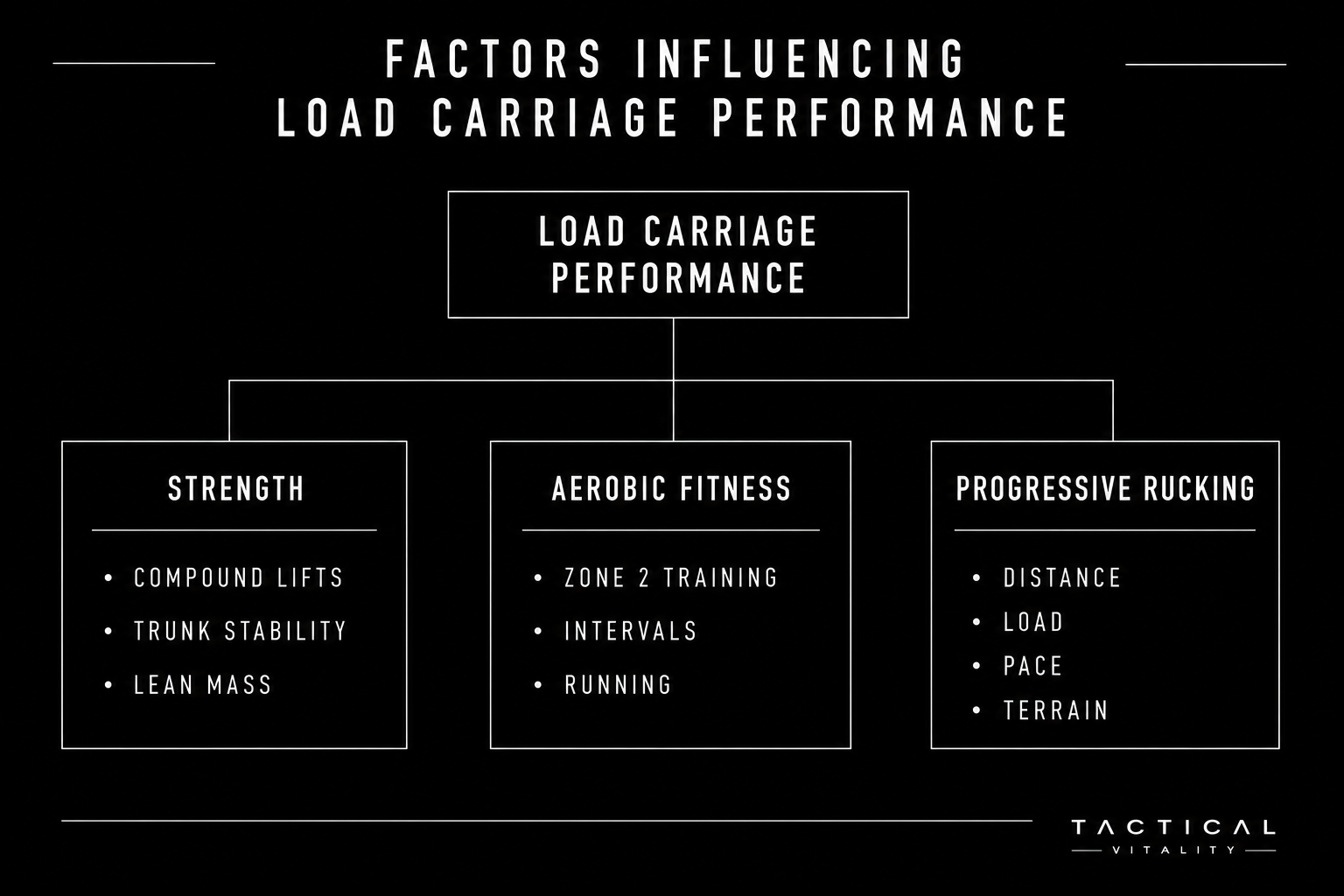
A systematic review and meta-analysis found that programs combining strength training, aerobic conditioning, and progressive load carriage practice produced substantially greater improvements than any single training method alone4.
Think of improving load carriage performance like building a high-performance vehicle. Strength builds the chassis. Aerobic fitness builds the engine. Rucking teaches you how to drive it. Neglecting one or more of those pillars will limit performance and increase injury risk. It is critical to look at the entire picture.
Pillar One: Strength Training
Carrying heavy loads places significant demands on the musculoskeletal system. Immediately following prolonged loaded marching, researchers consistently observe reductions in lower-body strength, trunk strength, and lower-body power5. The stronger an individual is (and the more muscle mass they have) before the march, the better they tolerate those demands and the less performance they lose over time.
Research examining military personnel found that every one-kilogram (2.2 pound) increase in fat-free mass increased the likelihood of successfully completing a 19.3-kilometer loaded march by approximately 24%6. Similarly, lean body mass was one of the strongest predictors of selection during U.S. Army Special Forces assessment7, a course that demands a significant amount of loaded movements.
Training studies tell the same story. Following twelve weeks of combined resistance training and interval conditioning, participants improved their loaded march performance by more than 7%8.
Strength doesn’t simply help you produce force. It helps preserve posture, maintain movement quality under fatigue, and reduce the likelihood that tissues become overloaded late in a march, because their capacity to tolerate load is greater than someone who is weaker and/or has less muscle mass.
Practical Takeaway
Train strength 2–3 times each week using compound movements that develop the entire body.
Prioritize exercises such as:
- Squats
- Deadlifts
- Romanian deadlifts
- Split squats
- Rows
- Overhead presses
- Pull-ups
- Loaded Carries, Pallof Presses, and other trunk stability movements
The goal is building a body capable of repeatedly carrying heavy loads without breaking down.
For a deeper dive into the science of strength training, check out my previous article on the different adaptations associated with resistance training.
Pillar Two: Aerobic Training
Although carrying a heavy pack feels like a strength challenge, rucking is primarily an aerobic activity. Most ruck marches involve sustained movement at a submaximal intensity, placing a high demand on the body’s aerobic energy system.
As aerobic fitness improves, moving at the same pace requires a smaller percentage of your maximum capacity. Heart rate remains lower, fatigue accumulates more slowly, recovery between efforts improves, and movement mechanics stay more consistent throughout the march.
In many ways, a long ruck resembles a long run. The primary difference is that a greater proportion of energy is devoted to moving an external load rather than simply propelling your bodyweight forward. This is why strength and muscle mass are also essential for load carriage performance. While the mechanical demands differ, both activities rely heavily on a well-developed aerobic system.
Aerobic fitness is also one of the strongest protectors against load carriage injury. Army research found that Soldiers running fewer than four miles per week had a 3.5- to 4-fold greater risk of load carriage injury than those with higher running volumes2. Likewise, during a demanding 34-kilometer loaded march, the fittest participants completed the event without dropouts, whereas nearly one in five participants in the lowest-fitness group failed to finish.
The takeaway is straightforward: strength builds your ability to carry the load, while aerobic fitness improves your ability to move effectively for prolonged periods. Developing both qualities together produces the greatest improvements in load carriage performance.
Practical Takeaway
Aim for 2–3 cardiovascular sessions per week using a balanced approach:
- One or two easy “Zone 2” sessions
- One higher-intensity interval session
- Prioritize running, as it consistently demonstrates one of the strongest relationships with ruck performance—likely because it is weight-bearing and shares similar movement demands.
Cycling, rowing, swimming, and other aerobic modalities remain excellent tools for improving cardiovascular fitness while reducing impact and managing overall training load.
For a deeper dive into building aerobic fitness, check out my previous article on aerobic training.
Pillar Three: Progressive Load Carriage Training
No amount of strength or aerobic training can fully prepare you to carry a heavy pack. At some point, you simply have to ruck.
This reflects the principle of specificity: if you want to improve a specific task, you must regularly practice that task.
Research consistently shows that training programs incorporating progressive ruck training outperform those relying on strength and aerobic conditioning alone4. Why? Because experienced ruckers become more efficient. They expend less energy, move more economically, and report lower levels of perceived exertion despite carrying the same loads. Interestingly, these improvements cannot be fully explained by differences in VO₂max, muscular strength, or muscle fiber type alone. Instead, repeated exposure appears to produce task-specific neuromuscular adaptations that only develop through rucking itself.
The same principle applies across nearly every aspect of performance. Squats will make you stronger. Running will improve your aerobic performance. Both contribute to better load carriage. But if your goal is to become highly proficient at moving under load, neither can fully replace the adaptations gained from progressively carrying a pack (Figure 1).
How to Progress Without Getting Hurt
If there’s one principle that separates effective load carriage training from injury-prone training, it’s this: The problem isn’t rucking—it’s sudden spikes in training load.
The human body adapts remarkably well to mechanical stress when that stress is introduced progressively. Problems arise when training load increases faster than the body can adapt.
This principle extends far beyond rucking. Across endurance sports, resistance training, and military populations, abrupt increases in workload consistently predict injury, while individuals who build a larger training base over time become more resilient to future demands. Load carriage is no exception.
One of the clearest examples comes from Swiss Army recruits. Rather than immediately exposing recruits to full operational marching distances, researchers implemented a progressive four-week marching program that gradually increased distance over time. The results were clear: recruits experienced 33% fewer injuries and 53% lower attrition than those following the standard training schedule9.
The lesson is simple: rucking itself isn’t inherently dangerous. Most overuse injuries occur when the workload exceeds your current capacity—not because carrying a pack is harmful.
Progress gradually, prioritize recovery, and allow your body time to adapt. Done intelligently, rucking doesn’t just become safer—it helps build stronger muscles, bones, connective tissues, and joints that are better prepared for the demands of both training and real-world tasks.
Five Variables You Can Progress
There are five primary variables that determine the difficulty of load carriage training:
- Load (how much weight you’re carrying)
- Distance
- Pace
- Frequency
- Terrain
The biggest mistake isn’t progressing one of these variables—it’s progressing too much, too soon. Increasing multiple variables simultaneously or making large jumps in a single variable quickly raises training stress and injury risk.
Instead, progress one variable at a time by a reasonable amount while keeping the others relatively stable. This approach requires patience, consistency, and planning, but it consistently produces better long-term results than repeatedly alternating between doing too little and too much.
Small, sustainable increases almost always outperform large spikes in training stress. A modest progression that keeps you healthy allows months of uninterrupted training. An aggressive progression that leads to injury often costs weeks or months of missed training and poor long-term outcomes.
Load
Military research consistently demonstrates that injury risk rises substantially once loads exceed approximately 25% of body weight2.
For most people, beginning around 10–15% of body weight provides enough stimulus to develop load carriage capacity while minimizing unnecessary injury risk. From there, gradually increase load as your body adapts. There are, however, situations where tactical athletes must carry substantially heavier loads during deployments, military schools, or operational missions. In these cases, heavier loads should be introduced strategically and progressively to prepare for the specific demands of the task. Make these periods the exception—not the foundation—of your training.
Distance
Distance is often the easiest variable to progress first.
Rather than immediately adding weight, allow your muscles, connective tissues, feet, and movement patterns to adapt by gradually increasing time under load.
For many athletes, increasing total distance by approximately 0.5–1 mile every week is a conservative starting point, assuming recovery remains good.
Pace
Most ruck training should be performed at a comfortable, conversational pace.
Faster rucking and ruck running certainly have a place when preparing for selection courses or timed events, but they shouldn’t become the norm.
Interestingly, research suggests that forced marching at speeds faster than your natural walking gait may produce greater joint loading than running with the same load10. If your profession requires faster paces, you’ll need to train for them. Just recognize that faster movement under load is a higher-stress stimulus that typically requires additional recovery and thoughtful programming.
Frequency
More isn’t always better. For most tactical professionals who are already strength training and running, one dedicated ruck session per week is enough to steadily improve performance.
Remember that rucking doesn’t occur in isolation. Your total workload also includes lifting, running, occupational demands, and recreational activity. Military research shows that injury risk rises as marching frequency increases, particularly when recovery is inadequate2.
Manage your total training load, not just the miles spent rucking.
Terrain
Terrain is often overlooked.
Flat, predictable surfaces make progression easier because they reduce unnecessary variability and allow you to control training stress.
As your capacity improves, gradually introduce hills, uneven trails, or more technical terrain as needed for your situation. These environments increase demand and better prepare you for real-world conditions—but, like every other training variable, they should be progressed gradually.
Sample 4-Week Load Training Block
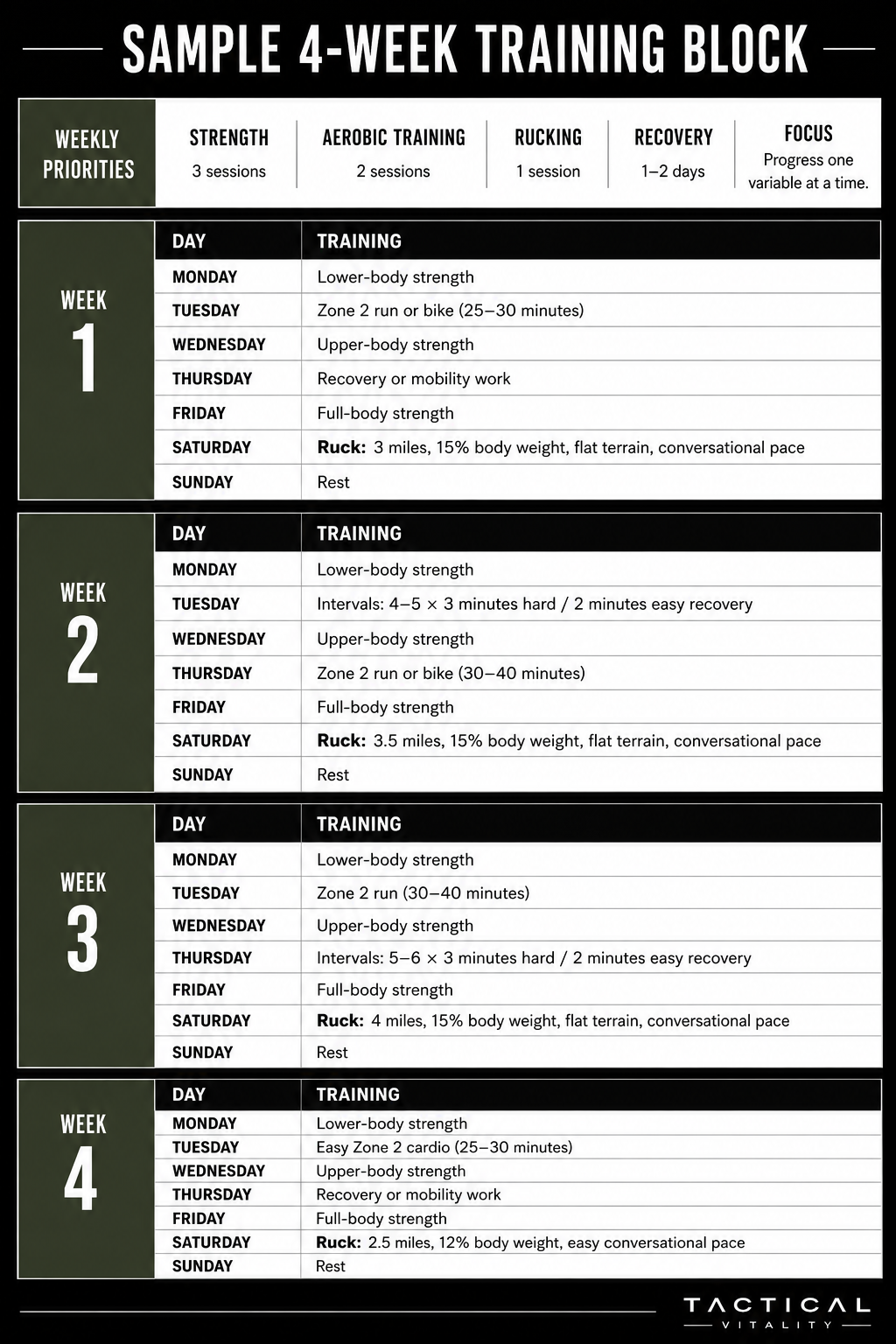
The following program illustrates how to integrate the three pillars of load carriage performance—strength training, aerobic conditioning, and progressive rucking—into a practical weekly schedule (Figure 2).
Rather than serving as a rigid prescription, think of it as an evidence-informed framework that can be adjusted based on your current fitness level, training history, occupational demands, and recovery capacity. The ruck volume shown is intentionally conservative and is designed for someone with a modest training base. Increase or decrease the starting volume as needed based on your current level of readiness.
It is also important to remember that this is one training block and is just a starting point—not the finish line. The goal is to complete the cycle, recover, then begin another by gradually progressing one or more training variables. Long-term, consistent progression—not any single four-week program—is what ultimately builds exceptional load carriage performance.
Rucking Isn’t Bad for Your Joints—Poor Training is
One of the most common criticisms of rucking is that it’s “bad for your joints”.
It’s an understandable concern. Carrying extra weight certainly increases the forces traveling through your hips, knees, ankles, and spine. But higher force does not automatically mean tissue damage.
In fact, the opposite can be true. Your muscles, bones, tendons, ligaments, and cartilage are living tissues that adapt to appropriately applied mechanical stress. The key isn’t avoiding loading—it’s applying enough loading to stimulate adaptation without exceeding your body’s ability to recover. This principle sits at the heart of nearly every effective training program.
Research has repeatedly shown that inactivity is not protective for joint health. Joint immobilization causes cartilage to thin, and reduces its ability to tolerate stress9. The same principle applies to bone. According to Wolff’s Law, bone remodels in response to the loads placed upon it. Weight-bearing exercise stimulates bone formation and increases bone mineral density. Conversely, prolonged inactivity accelerates bone loss. Your body was built to carry load. It simply needs time to adapt.
Finding the Tissue Loading Sweet Spot
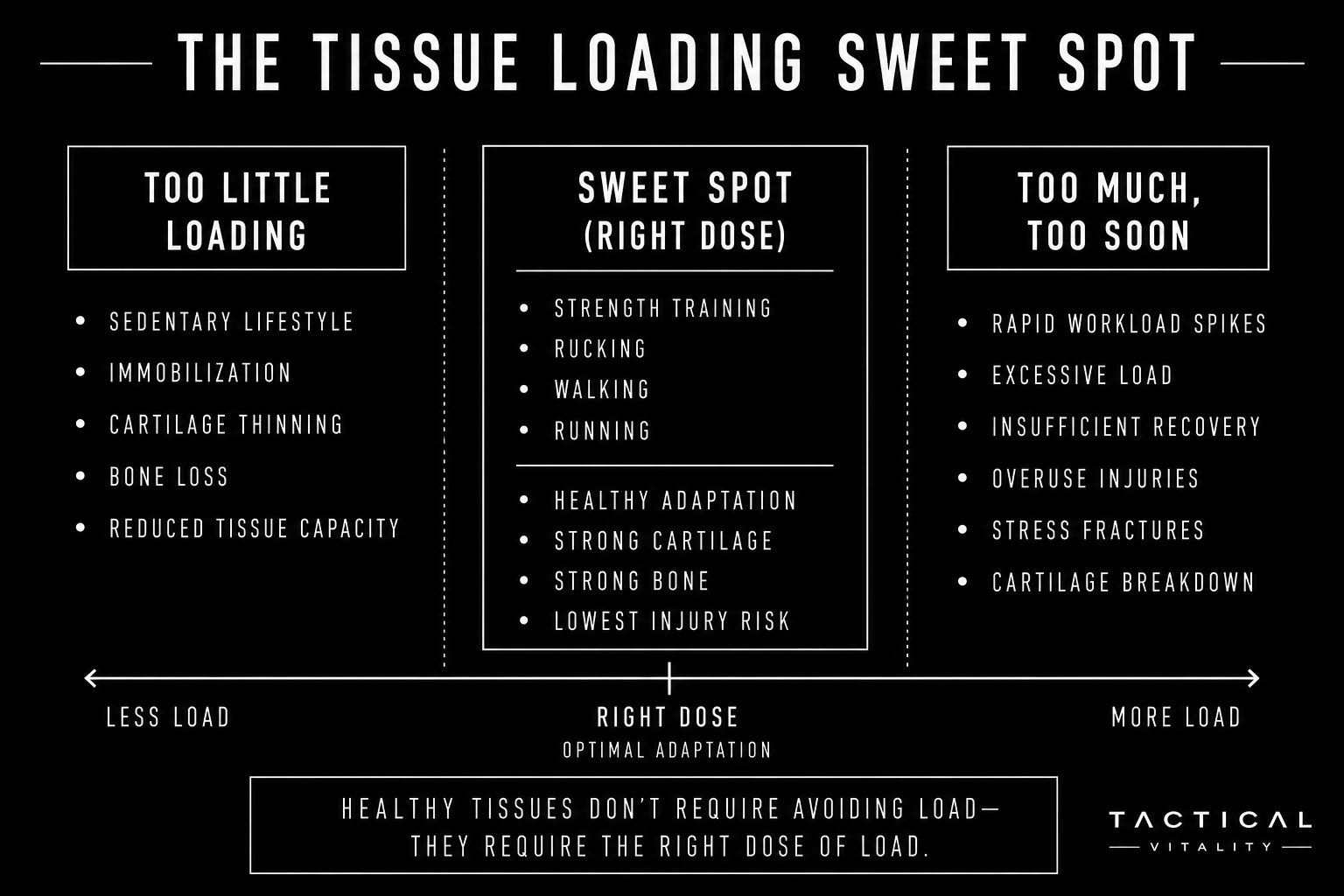
Load and joint/tissue health appears to follow a classic U-shaped relationship. Too little loading is not beneficial. Too much loading—especially when introduced too quickly—is also harmful.
Between those extremes lies a sweet spot, where tissues become stronger, more resilient, and better prepared for future demands (Figure 3). That is where intelligent training aims to keep you.
Good programming isn’t about eliminating stress—it’s about applying the right amount of stress at the right time, then allowing the body to recover and adapt before continuing to progress.
Load carriage follows the same principle. Rucking isn’t inherently harmful; poorly managed loading is. When introduced progressively and paired with adequate recovery, rucking can become an incredibly useful fitness modality.
Bottom Line
Rucking is often viewed as an inherently dangerous activity that inevitably leads to injury or joint degeneration. The evidence tells a different story.
Like any physical skill, load carriage is something that should be developed progressively over time. The risk doesn’t come from carrying a pack—it comes from asking your body to do more than it is prepared to handle.
With a foundation of strength training, aerobic conditioning, and progressive ruck training, you not only improve occupational performance but also build stronger muscles, bones, connective tissues, and joints that support long-term health and resilience.
Ultimately, intelligent programming, gradual progression, and consistent training transform load carriage from a common source of injury into a powerful tool for building durable, capable tactical athletes.
References
1. Prevalence of musculoskeletal injuries sustained during Marine Corps recruit training (Military Medicine)
2. Risk factors for injury associated with low, moderate, and high mileage road marching in a U.S. Army infantry brigade(Journal of Science and Medicine in Sport)
3. Musculoskeletal injuries and United States Army readiness part I: overview of injuries and their strategic impact(Military Medicine)
4. A systematic review of the effects of physical training on load carriage performance (Journal of Strength and Conditioning Research)
5. A systematic review and meta-analysis on the impact of military foot marches on performance—part 1: physical performance (Journal of Strength and Conditioning Research)
6. Long duration load carriage performance is associated with Army Combat Fitness Test scores and fat-free mass(Journal of Strength and Conditioning Research)
7. Anthropometrics and body composition predict physical performance and selection to attend Special Forces training in United States Army soldiers (Military Medicine)
8. Twelve weeks of concurrent resistance and interval training improves military occupational task performance in men and women (European Journal of Sport Science)
9. Adapted marching distances and physical training decrease recruits' injuries and attrition (Military Medicine)
10. The physiology and biomechanics of load carriage performance (Military Medicine)