
Making Sense of Pain

A Practical Pain Overview for Tactical Athletes
Introduction
Every tactical professional has experienced it. A knee that begins aching during a ruck. A shoulder that hurts during overhead pressing. A low back that stiffens after a long day in body armor. Inevitably, the same questions follow: why am I in pain, and what should I do about it?
The advice you often hear falls at two unhelpful extremes. The first is to just "push through it" because discomfort is part of the job. The second is to completely stop all activity until the pain disappears. In reality, ignoring symptoms allows minor tweaks to become larger problems, while prolonged rest erodes your fitness and your confidence in your body's durability.
Musculoskeletal injuries are the leading cause of outpatient medical encounters in the U.S. Army—notably, roughly 70% of injuries are overuse injuries—the result of accumulated training load exceeding capacity, not dramatic accidents. Furthermore, musculoskeletal injuries account for approximately 65% of soldiers medically unable to deploy.¹
Pain is a reality of physically demanding occupations. The goal shouldn’t necessarily be to prevent it entirely, but to understand what it is communicating and to respond intelligently. Pain is information. This article provides a practical framework for interpreting that information, making smarter training decisions, and knowing when to modify your training versus when to seek medical evaluation.
(Note: This is intended for the everyday aches and persistent symptoms of training, not the treatment of acute traumatic injuries. It is not a substitute for evaluation by a qualified healthcare professional.)
The Smoke Detector Principle
To understand why pain can sometimes be misleading, we first have to recognize its primary job: protection. Pain exists to identify potential threats (not necessarily real ones) and encourage you to alter your behavior to prevent harm.
Think of pain like a smoke detector. A good smoke detector is calibrated to sound the alarm before a fire becomes life-threatening. Occasionally, it goes off because you burned toast. That false alarm is an acceptable tradeoff because the consequences of missing a real fire are catastrophic.
The International Association for the Study of Pain defines pain as “an unpleasant sensory and emotional experience associated with actual or potential tissue damage.”² That word—potential—is key. It means your nervous system can produce pain even if no physical damage has occurred, simply because it senses a threat.
When the Alarm Stays On
This protective mechanism is incredibly useful during an acute injury, when protection really is important. But problems arise when pain persists long after tissues have healed.
Repeated or prolonged pain can amplify the transmission of pain signals in your spinal cord and brain—a process known as central sensitization. Your nervous system essentially becomes overly communicative of pain signals and loses its ability to suppress them the way it should. The pain is 100% real, but it no longer correlates to the amount of actual tissue damage present.³ Your body's smoke detector has simply become too sensitive.
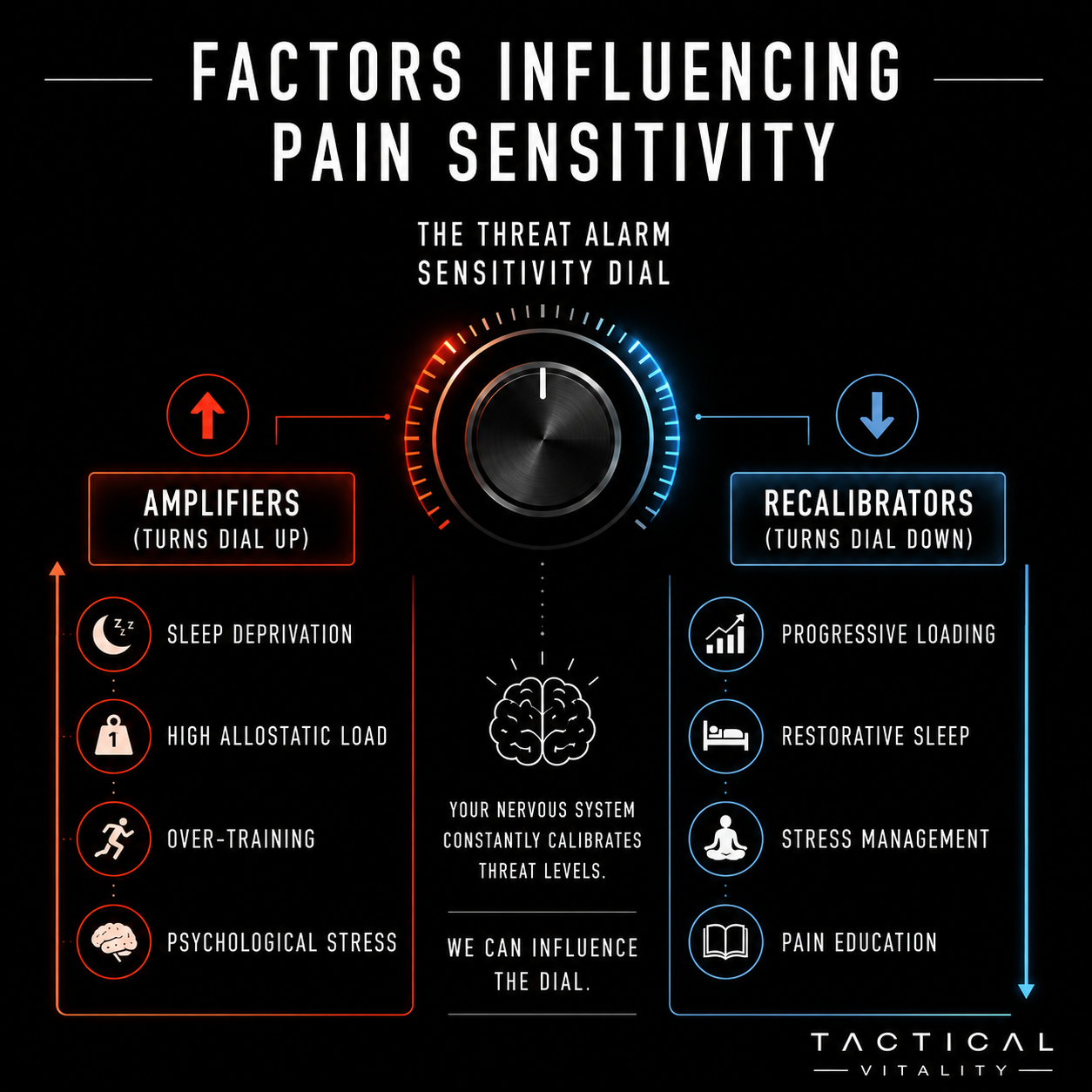
Fortunately, this doesn’t have to be permanent. Gradual exposure to physical activity, better sleep, stress management, and an understanding of how pain works can recalibrate this system and turn the alarm volume back down.
What Turns the Alarm Up?
For the tactical athlete, several occupational realities act as significant pain amplifiers (Figure 1):
- Poor Sleep: Research shows that a single night of sleep deprivation can increase pain sensitivity and weakens the body's natural ability to dampen pain.⁴ For an operator on shift work or a field exercise, lack of sleep actually lowers the threshold at which you feel pain.
- Psychological Stress: High occupational stress, anxiety, and catastrophic thinking are consistently linked to greater pain intensity and disability across a wide range of musculoskeletal conditions.⁵ This doesn't mean the pain is "in your head"—it means stress puts your nervous system on high alert.
- Fatigue and Under-Recovery: Hard training without sufficient recovery reduces your capacity to tolerate additional stress. As recovery drops, your nervous system becomes overly protective, often amplifying the pain experience.
Pain ≠ Damage
A common misconception is that pain is a direct measurement of tissue damage. In chronic or persistent conditions, this is often not true.
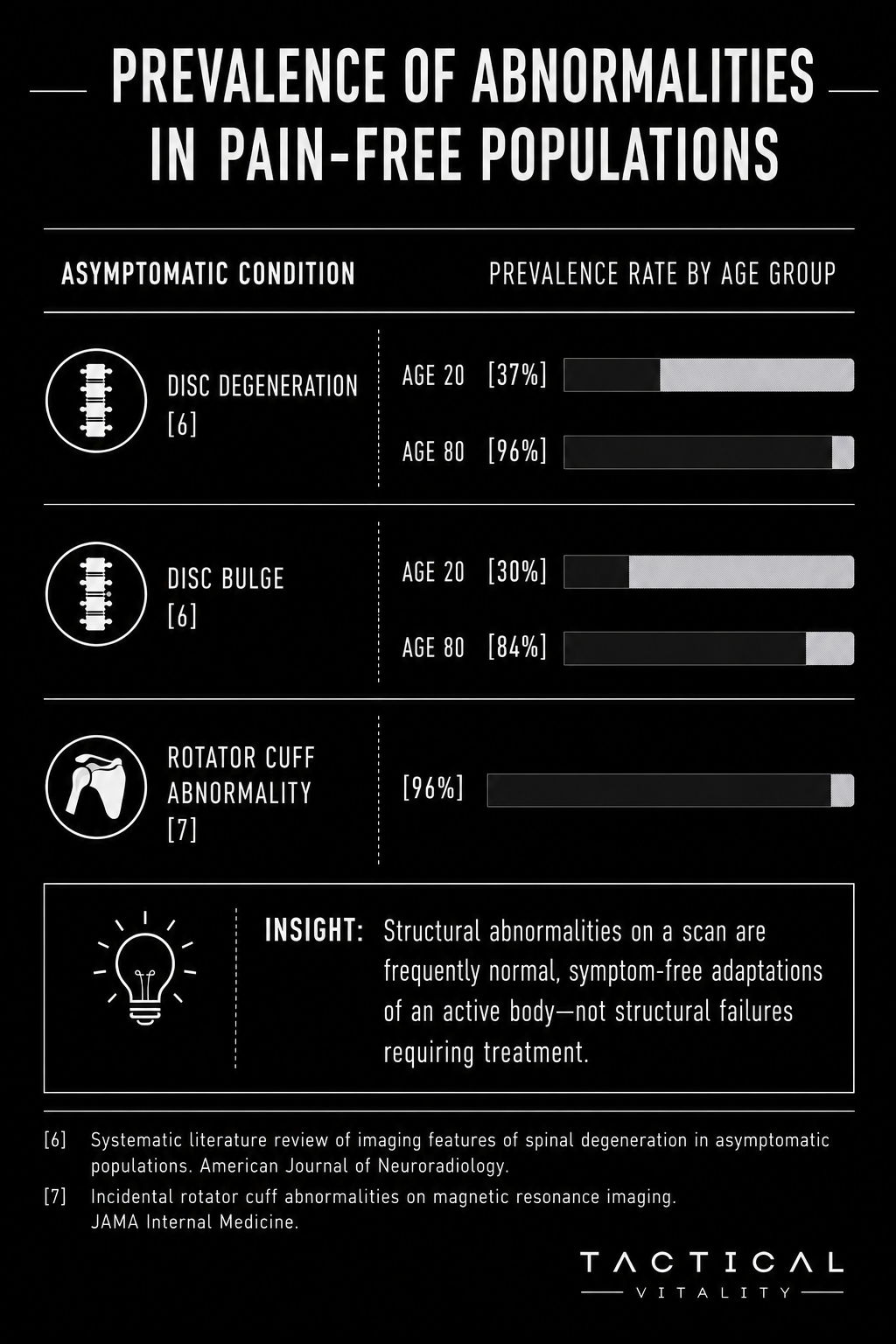
The clearest evidence comes from medical imaging. As a physical therapist, this is an obstacle that I have to navigate during patient encounters on almost a daily basis. Scans frequently reveal "abnormalities" in people who have absolutely zero pain (Figure 2):
- In a systematic review of over 3,000 pain-free individuals, disc degeneration in the spine was present in 37% of 20-year-olds and 96% of 80-year olds, and disc bulges were found in 30% of 20-year-olds and 84% of 80-year-olds.⁶
- A large MRI study of over 600 middle-aged participants showed rotator cuff abnormalities in 96% of pain-free shoulders, which was only marginally less than painful shoulders (98%).⁷. This data tells us that there is not always a clear relationship between tissue abnormalities and pain.
In the medical world, we often call these "wrinkles on the inside." They are common, maybe even expected changes to a body that has lived a hard, active life. Just because a scan shows a torn labrum or a bulging disc doesn't mean it's the source of your pain. In fact, placing too much emphasis on abnormal imaging findings can create unnecessary fear around movement and reinforce the false perception that our bodies are fragile.
This is why your symptoms, physical function, imaging findings (if applicable) and training history must be interpreted together. A scan is just one piece of the puzzle. (Of course, structural findings do matter for certain injuries such as fractures, tendon ruptures, neurological deficits, and other traumatic injuries—which is why clinical evaluation is vital—to help discern when imaging is and is not appropriate).
Two Common Mistakes
When faced with pain, tactical professionals usually make one of two errors:
- Ignoring It: Driven by tactical culture and a desire not to miss a deployment, selection, or school, tactical professionals push through the pain. But ignoring the information your body is sending removes your opportunity to intervene early. What could have been fixed with a minor training modification turns into a chronic issue that often causes downstream effects.
- Eliminating All Activity: Fearing further damage, the individual stops training entirely. Prolonged rest degrades aerobic fitness, strength, and tissue capacity, while reinforcing a psychological fear of movement.
The most productive response lies in the middle. Movement is usually part of the answer. Modifying your activity—by temporarily reducing volume, performing an alternative exercise selection, or limiting range of motion—allows you to maintain fitness, preserve tissue capacity, and safely recalibrate your nervous system so that a small issue doesn’t turn into a big one.
The Tactical Vitality Decision Framework
Pain shouldn't make your decisions for you, but it should inform them. This simple Traffic Light framework can help you determine how to proceed when dealing with everyday training aches.
🟢 GREEN — Train, Monitor, Proceed
The Signs:
- Mild symptoms that remain stable or improve as you warm up.
- Symptoms return to baseline within 24 hours.
- Movement quality and performance remain unchanged.
- No swelling or sharp, radiating pain.
The Action: Continue training as planned. Monitor the trend over time. Mild discomfort that doesn't limit function is often safe to train through.
🟡 YELLOW — Modify, Don’t Eliminate
The Signs:
- Symptoms progressively worsen during the training session.
- Pain takes longer than 24-48 hours to return to baseline.
- Noticeable breakdown in your form or overall performance.
The Action: Continue training, but modify the stimulus. Reduce the weight, cut the volume, perform a lower impact alternative movement, or swap the movement (e.g., switch from a barbell back squat to a goblet squat). Prioritize your sleep and recovery. If things don't improve in 1-2 weeks, seek an evaluation from a qualified professional.
🔴 RED — Stop and Seek Evaluation
The Signs:
- Significant traumatic injury or inability to bear weight.
- Significant amounts of swelling and/or bruising.
- Progressive numbness, true weakness, or radiating neurological symptoms.8
The Action: Stop training the affected area and seek prompt medical evaluation from a qualified healthcare professional. These are signs that a formal medical evaluation is necessary.
The Goal is Capability
A common misconception is that successful training is completely pain-free. If you train hard and work a demanding job, you will experience occasional aches and pains.
The practical goal shouldn’t be to never experience pain. The objective is to remain highly capable of meeting the physical demands of your life and occupation, while continuing to move in the right direction. By treating pain as information, understanding what amplifies it, and modifying your training intelligently, you are investing in your long-term durability.
References
7. Incidental rotator cuff abnormalities on magnetic resonance imaging (JAMA Internal Medicine)
8. Diagnosis and Treatment of Low Back Pain (LBP) (VA/DOD Clinical Practice Guidelines)