Concurrent Training for Tactical Athletes
The Science and Practice of Developing Strength and Endurance Together
Introduction
In our previous articles, we explored two foundational pillars of human performance: cardiorespiratory fitness and skeletal muscle strength. We discussed how cardiorespiratory fitness supports endurance performance, recovery, resilience, and long-term health. We also examined how skeletal muscle and strength contribute to tactical performance, healthy aging, and lifelong independence.
At first glance, these qualities seem to fit together naturally. After all, tactical professionals require both. Military personnel, firefighters, law enforcement officers, and other tactical athletes must be capable of producing high levels of force, moving efficiently under load, recovering from demanding physical tasks, and sustaining performance over prolonged periods of time1.
Yet despite the obvious importance of both qualities, many athletes continue to believe that developing one comes at the expense of the other.
Spend enough time in fitness circles and you will inevitably hear some version of the same warning: “Cardio kills your gains.” The belief that endurance training interferes with strength and muscle development has persisted for decades and remains common today. This concept, commonly referred to as the interference effect, has led some athletes to avoid cardiovascular training altogether out of concern that it will compromise strength and hypertrophy adaptations, or vice versa.
For tactical athletes, however, avoiding either quality is not a realistic option. The demands of the profession require both. This raises an important question: Can strength and endurance be developed simultaneously, or does improving one necessarily limit the other?
The answer is more encouraging than many people realize.
What Is Concurrent Training?
Concurrent training simply refers to the combination of resistance training and cardiovascular training within the same overall training program2.
A soldier who lifts weights while also running, a firefighter who strength trains while cycling, or a law enforcement officer who combines resistance training with rucking are all examples of concurrent training.
While the concept sounds straightforward, the question of whether these two forms of exercise interact with one another has been debated for decades. Resistance training primarily improves force production and muscle size, while cardiovascular training improves the body’s ability to deliver and utilize oxygen, sustain work, and recover from exertion.
Because these adaptations are different, some researchers and coaches have long wondered whether the pursuit of one might compromise the development of the other.
Understanding the Interference Effect
The interference effect describes the idea that endurance training may reduce gains in strength, power, or muscle size when performed alongside resistance training3.
The concept is often traced back to a landmark study by Robert Hickson in 1980. In that study, participants who performed both resistance and endurance training improved initially but eventually experienced a plateau in strength gains, while those performing resistance training alone continued to improve. This was one of the first studies to suggest that combining the two training modes could potentially limit strength development4. Since then, researchers have proposed several explanations for why this might occur.
Explanation #1: Conflicting Pathways
One of the most commonly discussed explanations for the interference effect involves two cellular signaling pathways known as mTOR and AMPK.
You do not need to understand the details of these pathways to understand the bigger picture. Think of them as two systems that help the body adapt to different types of training. Resistance training primarily activates mTOR, a pathway that plays an important role in muscle growth and strength development. Endurance training primarily activates AMPK, which helps regulate energy production and supports many of the adaptations associated with aerobic fitness.
Early researchers proposed that these pathways might compete with one another. If one pathway was encouraging the body to build muscle while the other was encouraging the body to become more efficient at producing energy, perhaps performing both types of training would limit progress in one or both areas.
This idea became one of the major theoretical explanations for the interference effect and remains part of the discussion today. However, when researchers began studying concurrent training in humans, the results were less concerning than many initially expected5.
While some early laboratory and animal studies suggested that AMPK could reduce mTOR signaling, human studies have generally failed to demonstrate meaningful interference when strength and endurance training are combined appropriately. Multiple studies have shown that endurance training does not appear to impair many of the key processes responsible for strength and hypertrophy adaptations.
The molecular science helps explain where concerns about concurrent training originated. However, when we step back and look at what actually happens in real people over weeks and months of training, the evidence suggests that strength and endurance can usually be developed successfully at the same time6.
Explanation #2: Cumulative Fatigue
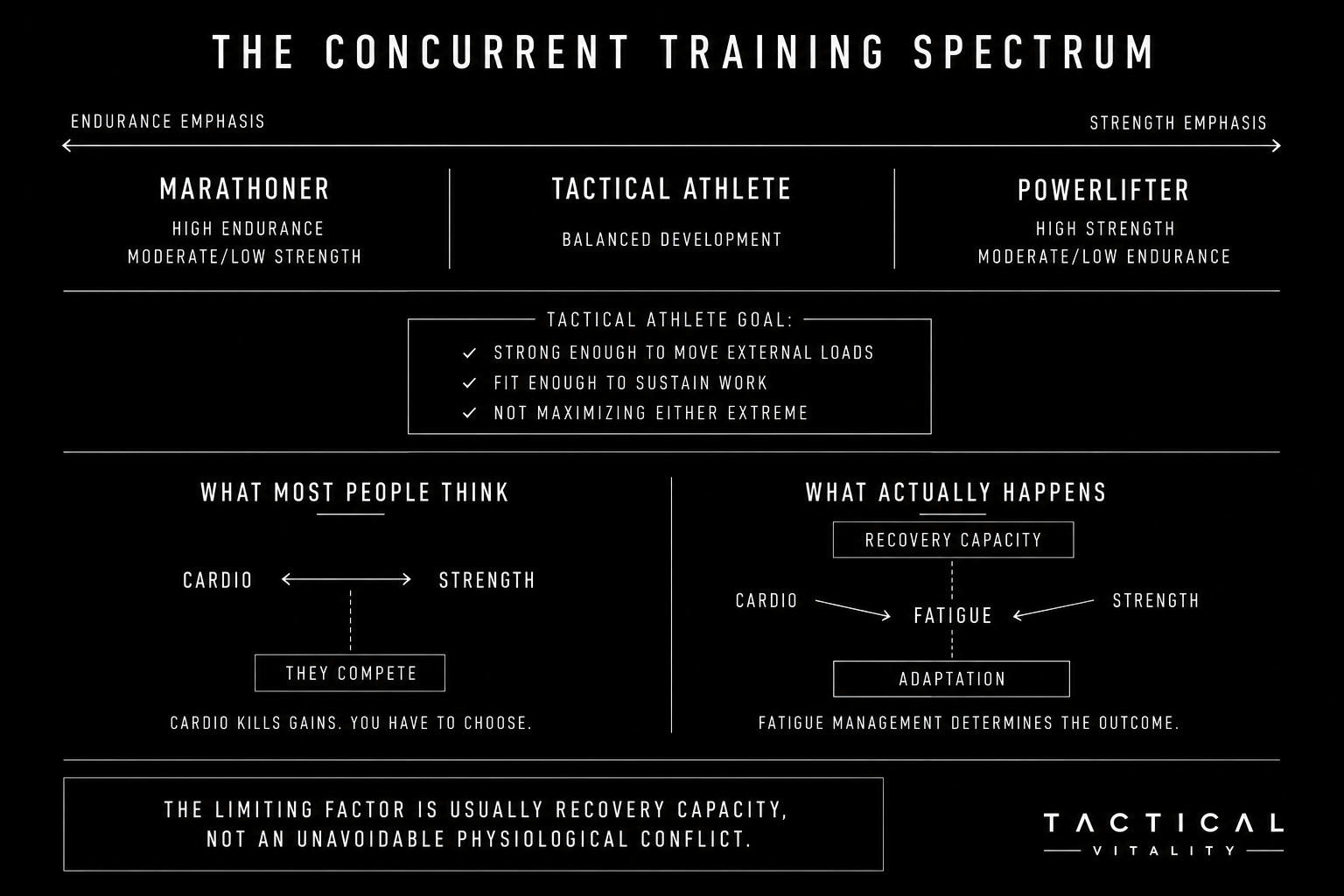
There is also a much simpler explanation for the interference effect: fatigue. Training creates fatigue. As total training volume increases, recovery demands increase as well. At some point, additional training can exceed an athlete’s ability to recover. When this occurs, performance suffers and adaptations may be reduced.
From a practical standpoint, this likely explains much of what athletes experience when they believe cardio is interfering with strength gains. An athlete who is already performing a demanding strength program and suddenly adds several hours of endurance training each week may simply be accumulating more fatigue than they can effectively recover from.
This distinction matters because it changes the solution. Rather than eliminating cardiovascular training altogether, the goal becomes intelligently managing overall training volume and recovery. It is also important to remember the context of Hickson’s original study. Participants trained six days per week while performing both high-intensity resistance and endurance training. This represents a level of combined training volume that far exceeds what most athletes realistically perform today7.
For most athletes, the challenge is not that strength and endurance cannot coexist. The challenge is finding the right balance between training stress and recovery. This concept can be visualized in figure 1 below.
What Does the Research Actually Show?
The physiology behind concurrent training is interesting, but the more important question is whether it actually affects long-term outcomes.
Overall, the evidence is reassuring. Over the past several decades, researchers have extensively studied concurrent training in athletes, military personnel, and recreationally active individuals. The general conclusion is that most people can successfully improve strength, build muscle, and develop cardiovascular fitness at the same time7.
There are, however, some important nuances.
Explosive power appears to be more sensitive to concurrent training than maximal strength or muscle growth7. Athletes whose primary goal is maximizing sprint performance, jumping ability, or explosive power may experience a small reduction in power development when large amounts of endurance training are performed alongside resistance training.
The type of endurance training also appears to matter. Several studies have found that running may create more interference than lower-impact modalities such as cycling2. This is likely related to the greater overall recovery demands associated with running. In simple terms, running tends to create more musculoskeletal fatigue than cycling. As we will discuss later, though, this does not mean running should be avoided.
Volume matters as well. The evidence suggests that higher frequencies and longer durations of endurance training are more likely to negatively affect strength and power adaptations than moderate amounts of cardiovascular training8. This should not be surprising. Most athletes have experienced some version of this phenomenon. A hard lower-body lifting session performed after a long run usually feels different than the same workout performed while fresh. Likewise, an athlete attempting to maximize marathon performance and powerlifting performance simultaneously will likely face greater challenges than someone pursuing more balanced goals.
The key takeaway is that the dramatic interference effect often described in fitness culture does not appear to occur in most athletes when training is programmed appropriately. Strength and endurance can be developed simultaneously. The challenge is not whether it is possible. The challenge is managing training stress and recovery effectively.
Prioritization
One of the most common questions athletes ask is whether they should prioritize strength training or cardiovascular training.
My recommendation is simple: prioritize whichever quality is most in need of improvement. Every athlete enters training with different strengths, weaknesses, goals, and training histories. Someone with a strong endurance background may benefit from dedicating additional time and resources toward strength development. Conversely, an athlete with years of lifting experience but poor cardiovascular fitness may benefit from placing greater emphasis on aerobic development.
The goal is not to maximize one quality while neglecting the other. The goal is to continue training both while temporarily emphasizing the quality most deserving of improvement.
Exercise Order
If you perform two training sessions in the same day, it generally makes sense to complete the higher-priority session first.
This allows the most important training to be performed while you are physically and mentally fresh. Research suggests that performing resistance training before endurance training may produce slightly better lower-body strength adaptations compared to the reverse order8. However, the practical importance of training order is often overstated.
For most athletes, consistently completing high-quality training sessions matters far more than obsessing over the perfect sequence. If scheduling constraints require endurance training before strength training, it is still possible to make excellent progress.
If explosive power is a major priority, separating strength and endurance sessions by several hours may be beneficial7.
Training Frequency
There is no universally optimal training frequency. For many tactical athletes, two to three resistance training sessions and two to three cardiovascular training sessions per week represent a reasonable starting point. From there, training volume can be adjusted based on goals, recovery capacity, and operational demands. More detail on training volume for cardiovascular fitness can be found here, with more detail on resistance training volume here.
A strength-focused athlete may spend more time in the weight room while maintaining a modest amount of cardiovascular training. An athlete preparing for a demanding endurance event may temporarily shift the balance in the opposite direction. The appropriate balance depends on the athlete.
Exercise Selection
A final consideration involves exercise selection. Tactical athletes should always remember the principle of specificity. The body adapts specifically to the demands imposed upon it. Because military personnel, firefighters, and many law enforcement professionals must run, move under load, and spend significant time on their feet, at least some cardiovascular training should involve weight-bearing activities such as running, rucking, hiking, or incline walking.
At the same time, lower-impact modalities such as cycling, rowing, and similar forms of conditioning can be valuable tools for accumulating additional cardiovascular training volume while reducing recovery demands. This is one reason many coaches incorporate a variety of endurance modalities into tactical training programs. Weight-bearing activities help prepare athletes for occupational demands, while lower-impact options allow additional aerobic work without creating excessive fatigue.
The reality is that maximizing strength development and maximizing endurance performance are not always perfectly aligned goals. Tactical athletes are not training to become powerlifters or marathon runners. They are training to meet the demands of their profession. Programming should reflect that reality.
Conclusion
Rather than viewing strength and endurance as competing priorities, tactical athletes should view them as complementary adaptations that work together to support performance, readiness, and long-term health.
For most people, the practical challenge is balancing training stress with adequate recovery. The goal is to build a resilient, adaptable body capable of meeting the demands of today while remaining healthy and capable decades from now. Strength helps you produce force and manage external loads. Cardiovascular fitness helps you sustain work, recover from exertion, and continue performing under fatigue.
For the tactical athlete, these qualities are not competing priorities. They are complementary tools that work together to support performance, readiness, and long-term health.
References
- Physical training considerations for optimizing performance in essential military tasks (European Journal of Sport Science)
- The effects of concurrent aerobic and strength training on muscle fiber hypertrophy (Sports Medicine)
- Interference between concurrent resistance and endurance exercise: molecular bases and the role of individual training variables (Sports Medicine)
- Interference of strength development by simultaneously training for strength and endurance (European Journal of Applied Physiology)
- AMPK vs mTORC1 signaling: genuine exercise effects of differentiated exercise in humans (Scandinavian Journal of Medicine and Science in Sports)
- Resistance exercise induced mTORC1 signaling is not impaired by subsequent endurance exercise in human skeletal muscle (American Journal of Physiology, Endocrinology and Metabolism)
- Compatibility of concurrent aerobic and strength training for skeletal muscle size and function: an updated systematic review and meta-analysis (Sports Medicine)
- The physiological effects of concurrent strength and endurance training sequence: a systematic review and meta-analysis (Journal of Sports Science)