Structuring Training for Long-Term Success
A Tactical Athlete's Guide to Periodization and Programming
Introduction
In our previous articles, we established why resistance training is a non-negotiable asset for the tactical athlete, explored how to train for specific adaptations like power and strength, and detailed the principles of intelligently managing training load. Now, we arrive at the final piece of the puzzle: organizing it all into a coherent, sustainable plan. This is where the concepts of periodization and programming become essential. For the tactical athlete, whose career and safety depend on long-term physical readiness, understanding how to structure training is just as critical as the training itself.
Periodization vs. Programming
When we talk about training, two terms often come up—periodization and programming—and while they’re closely related, they’re not the same thing.
Periodization is the big-picture plan: how training is organized and adjusted over time to help an athlete improve, stay healthy, and be ready when it matters most. It’s not a rigid schedule but a flexible, ongoing process that adapts based on how the athlete responds and integrates factors like recovery, nutrition, and overall readiness.
Programming, on the other hand, is how that plan is carried out day to day—the specific exercises, sets, reps, and methods used to deliver the training stimulus.
Put simply, periodization sets the direction, and programming is how that direction is executed. For tactical athletes, understanding this distinction matters. The environment is unpredictable and the demands are broad. Recognizing the difference helps tactical athletes train with intention—adjusting when needed, avoiding unnecessary breakdown, and building performance that holds up over time.
The Periodization Hierarchy
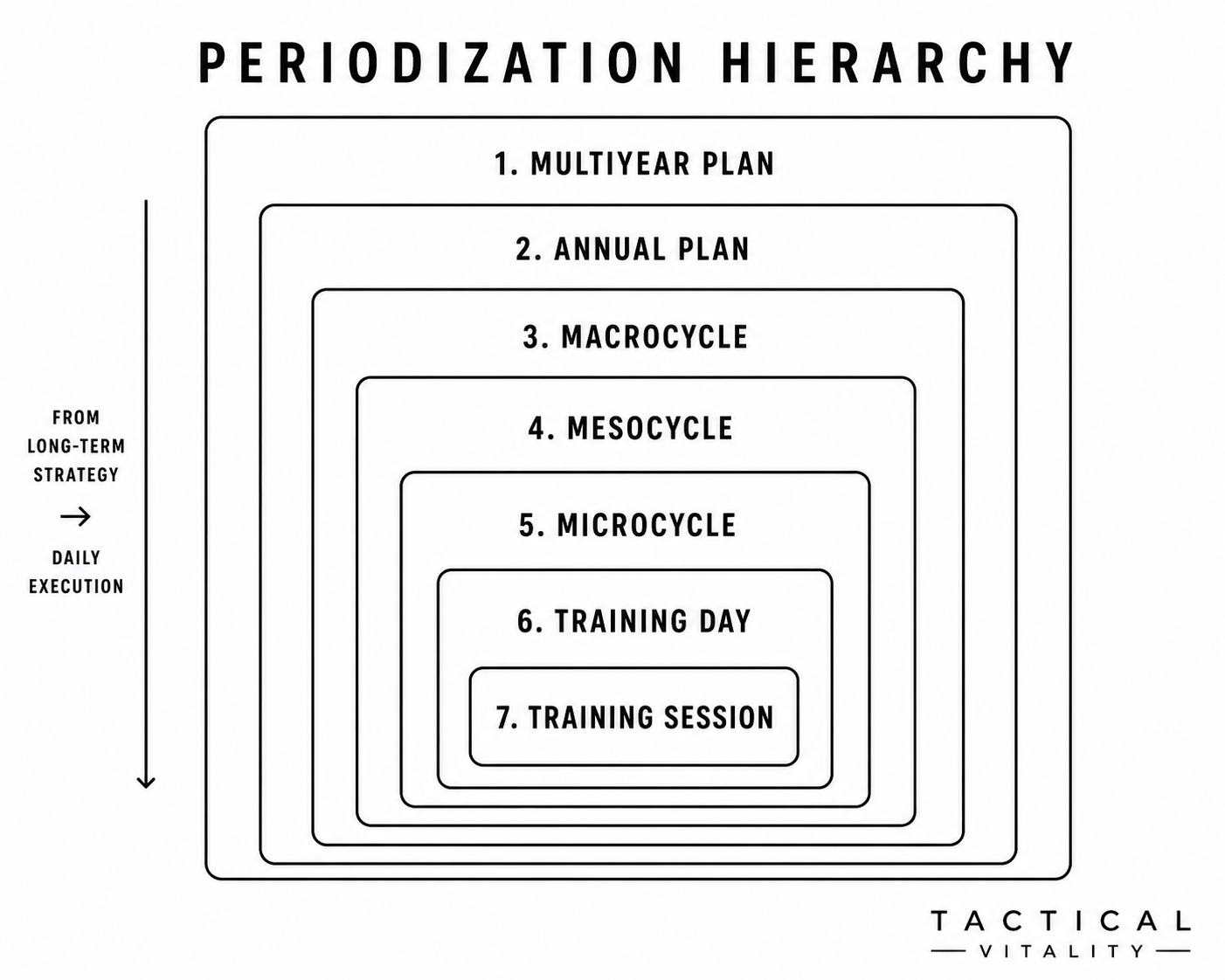
Periodization is organized within a clear hierarchy that helps structure training across multiple timeframes, from long-term planning down to individual sessions. At the highest level is the multiyear plan, which outlines the progression of training goals over several years, followed by the annual plan that organizes a single year of training. Within this, training is divided into macrocycles, which represent broad phases that typically last several months. Next are mesocycles, which are smaller blocks of training typically lasting a few weeks. These are further broken down into microcycles, often structured as weekly training plans, which guide the day-to-day organization of training. At the most detailed level are the individual training days and sessions, where specific exercises and workloads are implemented. This hierarchy can be visualized in figure 1 below.
For tactical athletes, this hierarchy provides structure without rigidity. While the operational environment rarely allows for perfectly planned training cycles, understanding how training is organized across these levels allows for more effective adjustments when plans inevitably change. It ensures that even when training is disrupted, the overall direction remains intact—supporting both performance and long-term durability.
Periodization Models
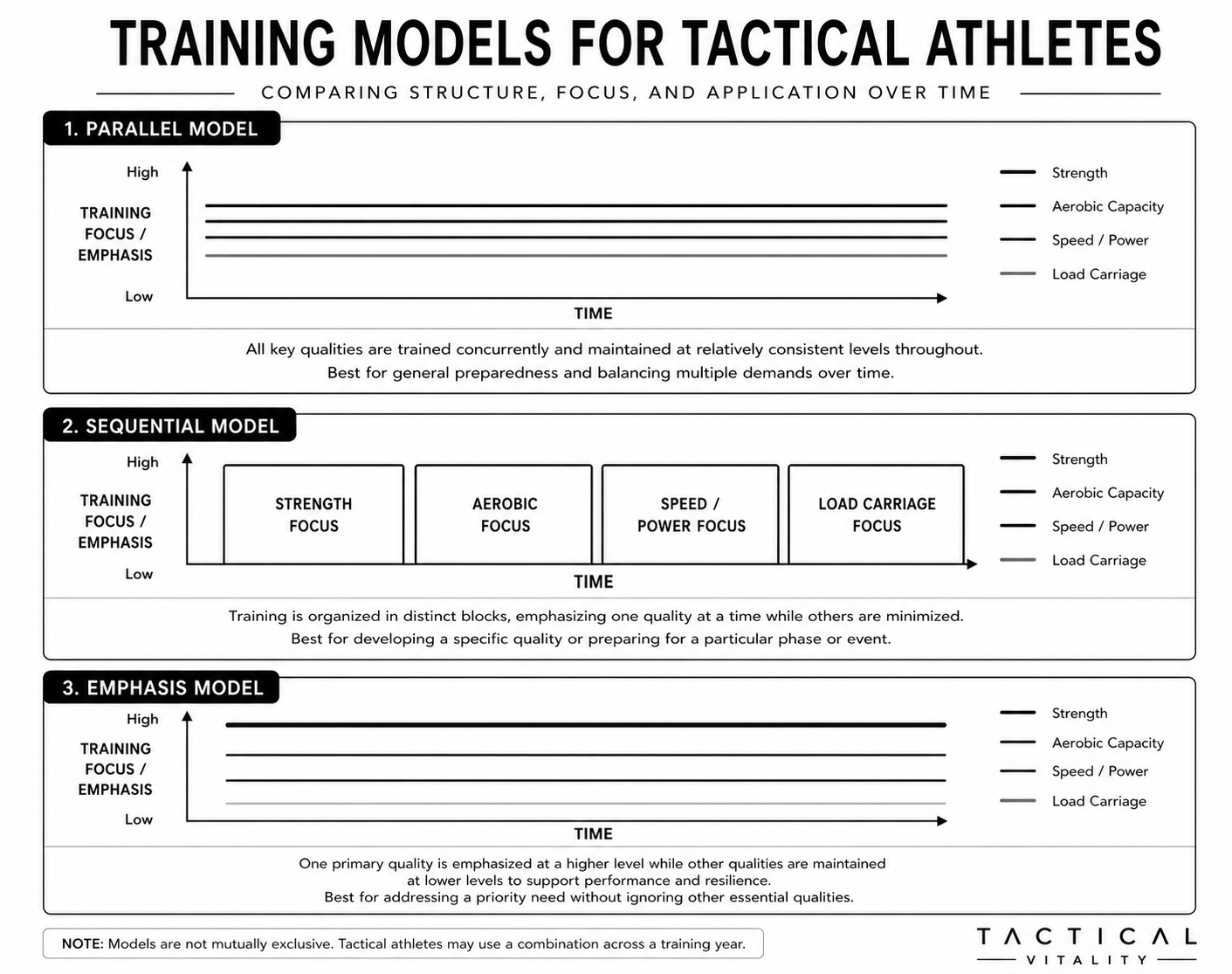
Once a general framework for periodization is established, the next question becomes how training is actually organized. Several primary models exist, each offering a different approach to developing and maintaining performance qualities. The most common include the parallel model, where multiple qualities are trained simultaneously; the sequential model, where specific qualities are emphasized in blocks; and the emphasis model, which blends aspects of both.
Each approach has its strengths and limitations, and no single model is universally superior. That said, certain models lend themselves more naturally to the environment of a tactical athlete. Because these populations must maintain a broad range of capabilities while remaining ready for unpredictable tasks, approaches that allow for the concurrent development and maintenance of multiple qualities may be particularly useful (parallel and emphasis). Still, context matters. Training age, operational demands, injury history, and time constraints all influence which model is most appropriate at a given time.
- Parallel Model: Multiple fitness qualities (e.g., strength, aerobic capacity, power) are developed simultaneously. For tactical athletes, this is often the most practical approach, as it ensures no single capacity is neglected. However, progress in any one area may be slower compared to more focused models.
- Sequential Model: Training is organized into distinct blocks, with each block dedicated to a single quality. For example, an athlete might complete a four-week hypertrophy block, followed by a four-week strength block. This can lead to rapid gains in the emphasized quality but may result in the temporary decline of others.
- Emphasis Model: A hybrid approach where one or two qualities are prioritized while others are trained at a maintenance level. This allows for focused development without letting other capacities deteriorate, making it a highly effective strategy for tactical athletes who need to improve a specific weakness while staying well-rounded1. A summary of these models can be visualized in figure 2 below.
Conclusion
In this series, we have journeyed from the foundational importance of muscle and strength to the specific physiological adaptations that drive performance. We've navigated the complexities of managing training load and now have a framework for structuring it all through periodization and programming.
By understanding these interconnected concepts, the tactical athlete can move beyond simply working out and begin training with intention. This distinction is the key to maximizing professional performance in a way that is sustainable and, just as importantly, allows you to reap the long-term health benefits of resistance training long after your career is over. We can only enjoy the profound, lifelong rewards of being strong and capable if we build a system that allows us to train for a lifetime.
References
- French, D. N., & Torres-Ronda, L. (Eds.). (2022). NSCA’s Essentials of Sport Science. Human Kinetics.