Navigating Training Load for Sustainable Performance
A Guide to Balancing Stress and Recovery Effectively
Introduction
In our previous articles in this series, we established why resistance training is a non-negotiable asset for the tactical athlete’s performance and long-term health, and we explored how to train for the specific adaptations of power, strength, hypertrophy, and muscular endurance. Now, we turn to a critical, often-overlooked variable in the training equation: managing training load.
For the tactical athlete, life is an unpredictable sequence of high-stress demands. The ability to perform is not just about being fit in the gym, it's about being resilient enough to handle a grueling shift, a sudden call-out, or a physically demanding task after a hard week of training. This requires a smarter approach than simply "more is better." Understanding the relationship between training, stress, and recovery is paramount to making sustainable progress, avoiding injury, and preventing overtraining. This article will provide you with the conceptual tools to navigate that balance.
The Foundation of Adaptation: General Adaptation Syndrome
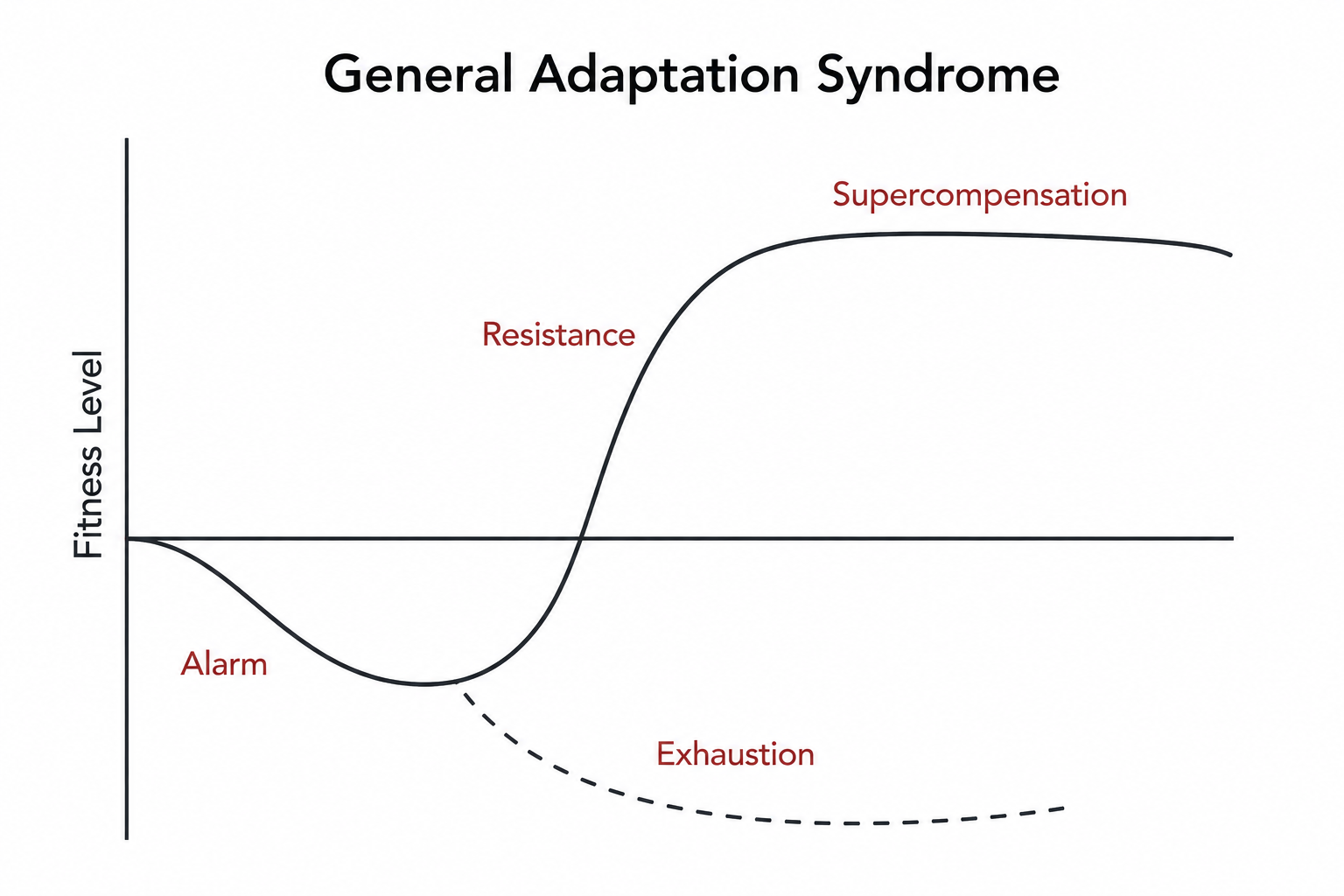
First proposed by endocrinologist Hans Selye, the General Adaptation Syndrome (GAS) is a model that describes the body’s predictable response to any stressor—be it physical, mental, or emotional¹. While its applicability is broad, it provides a powerful framework for understanding how we respond and adapt to resistance training.
- Definition: GAS outlines the three-stage process our body undergoes when exposed to a stressor that disrupts its state of balance, or homeostasis. The goal of training is to purposefully disrupt this balance to cultivate a new, higher level of capacity.
- The Three Phases of GAS:
- 1. Alarm Phase: This is the initial response to the training stimulus. The workout stresses the body, causing fatigue and a temporary decrease in performance.
- 2. Resistance Phase: Following the initial alarm, the body begins the recovery process. With adequate rest, nutrition, and sleep, it repairs itself and adapts to better handle future stressors. This adaptation, often called supercompensation, elevates our performance capacity above the original baseline.
- 3. Exhaustion Phase: If the stress is too great, too frequent, or if recovery is insufficient, the body cannot adapt. This leads to the exhaustion phase, where performance stagnates or declines. This process can be visualized in figure 1 below.
- Why It Matters: The entire process of getting fitter is a perpetual cycle of stress, recovery, and adaptation creating a new, higher baseline. Problems arise when we chronically overstress, under recover, or some combination of the two, leading us towards exhaustion and compromising our fitness gains. Understanding this concept helps us differentiate between productive training and counterproductive over-training. Being familiar with the terms below can helps distinguish between productive periods of overextension in our training compared to unproductive ones:
- Functional Overreaching: A planned, temporary intensification of training that pushes an athlete into a state of fatigue. Performance drops, but is followed by a period of recovery that allows for a supercompensation effect. This is a strategic tool used to improve performance.
- Non-Functional Overreaching (NFOR): When the training stimulus is too high for too long without adequate recovery. Performance drops significantly and eventually returns to baseline, but we do not get a supercompensation effect. It results in our training efforts not producing improvements in performance.
- Overtraining Syndrome (OTS): A state of chronic maladaptation characteriz by chronic fatigue, hormonal disruption, mood disturbances, sleep disruption, and persistent underperformance. Recovery can take many months or even years. This is somewhat rare.
Allostatic Load: The Sum of All Stress
As tactical athletes, it is vital to remember that training does not happen in a vacuum. The concept of allostatic load, which was discussed in a previous article on stress, posits that stress is cumulative. Physical stress from training, psychological stress from your job, emotional stress from family life, and environmental stressors like heat and cold are cumulative. A tactical operator managing high operational tempo, irregular sleep schedules, and family pressures cannot tolerate the same training load as a professional athlete whose life is structured entirely around training and recovery.
During periods of high life stress, your ability to recover from training is diminished. Pushing harder in the gym during these times will not result in improved performance if you do not have the capacity to absorb and properly recover from the load you are exposing yourself to in training. The intelligent athlete develops the awareness to reduce training volume or intensity when allostatic load is high and knows when to push harder during periods of lower external stress.
Listening to Your Body: External vs. Internal Load
To manage this flexible process, we need to understand the difference between what we do and how our body responds.
- External Load: This refers to the objective, measurable work you perform. It's the sets, reps, weight lifted, distance run, speed, etc. It is the work that you do.
- Internal Load: This is your body's physiological and psychological response to the external load. While it can be measured with objective tools like heart rate monitors, one of the most powerful and accessible tools for measuring it is subjective: the Rating of Perceived Exertion (RPE)².
RPE is a scale, typically from 1 to 10 (Although some scales vary, for example some that are cardiovascular based will range from 6-20), that quantifies how hard something felt. An RPE of 1 is a minimal effort, very close to complete rest. An RPE of 10 is a maximal effort with nothing left in the tank. This can be used in the context of both resistance training and cardiovascular training, or really any situation where you need to anchor to an effort level. RPE is generally a very solid internal load measure that pairs well with external load measures to identify tolerance to training loads, and can allow us identify times when we need to increase our recovery. See figure 2 below.
Why It Matters: Cross-referencing external load with internal load (RPE) provides critical insight into your readiness. An external load of 5 sets of 5 reps at 315 pounds on the squat might feel like an RPE of 7 on a day when you are well recovered. However, that same external load could feel like an RPE of 9 after a 24-hour shift with minimal sleep. If you notice that the same workout is progressively feeling harder (RPE is climbing) over weeks without a corresponding increase in external load, it is a sign that you need to recover. Listening to this sign and temporarily reducing your training load is often the smartest long-term decision you can make.
The Fitness-Fatigue Model
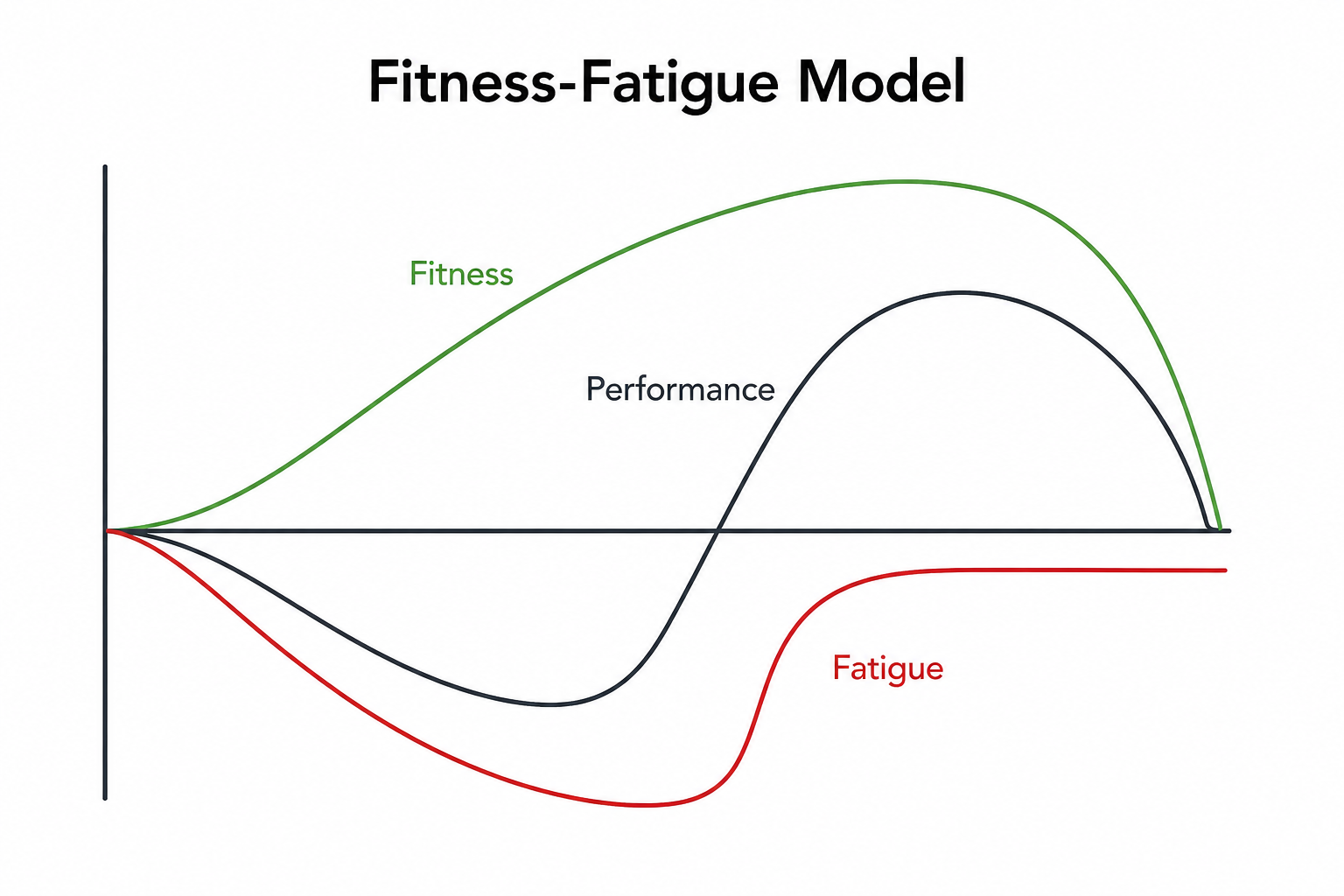
A final, complementary model to understand is the Fitness-Fatigue Model. It proposes that your state of readiness or performance at any given time is the difference between your accumulated fitness and your accumulated fatigue.
- How It Works: Training generates both fitness and fatigue. The fitness gains are generally longer long-lasting and resilient, while the fatigue is significant but dissipates relatively quickly. The crucial insight from this model is that fatigue dissipates about twice as fast as fitness.
- Why It Matters: This model explains why you rarely feel your absolute best in the middle of a demanding training block. Although your fitness is increasing, you are also carrying fatigue, which masks your true performance potential. It also provides the scientific rationale for tapering—the practice of strategically reducing training load before a competition or test. This reduction allows fatigue to drop off sharply while your hard-earned fitness remains high, leading to a peak in performance precisely when you need it. For tactical athletes, understanding this means accepting that periods of high fatigue are a necessary part of the process to drive adaptation, but that expressing that fitness fully requires planned periods of lower load (deloads) to let fatigue subside. See figure 2 below.
Conclusion
True, sustainable high performance for the tactical athlete is built on a foundation of intelligent work. Understanding and applying the concepts discussed today can help you train smarter.
Restraint, rest, and recovery are not signs of weakness; they are the periods when adaptation occurs. Pushing hard is part of the equation, but listening to your body and respecting its need for recovery is what turns that hard work into real, lasting progress.
References
- Selye, H. (1950). Stress and the General Adaptation Syndrome. British Medical Journal, (4667), 1383–1392.
- French, D. N., & Torres-Ronda, L. (Eds.). (2022). NSCA’s Essentials of Sport Science. Human Kinetics.