
Understanding the Adaptations to Resistance Training
A Tactical Athlete's Guide to Power, Strength, Hypertrophy, and Muscular Endurance
Introduction
In our last article, we established why muscle and strength is a non-negotiable asset for the tactical professional's performance and long-term health. Now, we'll explore how to build that asset.
The human body adapts specifically to the demands placed upon it, a principle known as SAID (Specific Adaptation to Imposed Demands). Resistance training is the tool we use to direct this process, allowing us to target four distinct physiological outcomes: Power, Strength, Hypertrophy, and Muscular Endurance. The deliberate manipulation of training variables—load, speed, volume, and rest—determines which of these pillars you build. Each adaptation is important, and optimal tactical performance requires a comprehensive approach that develops all four. Understanding these concepts is fundamental to designing an intelligent and effective training program.
Power
- Definition: Power is the ability to generate force quickly. Think of the difference between slowly pushing a car and the explosive energy needed to jump onto a box. Both require force, but the jump requires power. It’s strength produced quickly.
- Why It Matters: Explosiveness is a cornerstone of tactical performance. Whether you're sprinting from a threat, hoisting a partner over a wall, or rapidly moving from a kneeling to a standing position, power is what allows you to act with speed. It's also critical for healthy aging. The ability to quickly get up from a chair, ascend stairs, or react to a stumble to prevent a fall is a function of power. Research shows that as we age, our power output naturally declines over time. But regularly training for power can help you hold onto that vital physical ability for much longer1.
- How to Train It: The key to training power is intent and quality. Every time you perform a repetition, you must try to move as fast as possible. To do that effectively, you need to be well-rested and fresh. Quality is critical.
- Driver: The intensity (load and speed) of the movement is more important than the total volume (sets/reps) of the movement. Too much volume creates fatigue, which slows you down and prevents you from training fast enough to improve power.
- Intensity: A "sweet spot" for power development exists between 30-85% of your 1 Rep Max (1RM). Lifting too light doesn't require enough force for optimal power, while lifting near your absolute max is too heavy to move quickly. Somewhere in between allows you to have an optimal combination of force and velocity, the two components of power. Since the range is wide, training across a broad range of intensities is recommended.
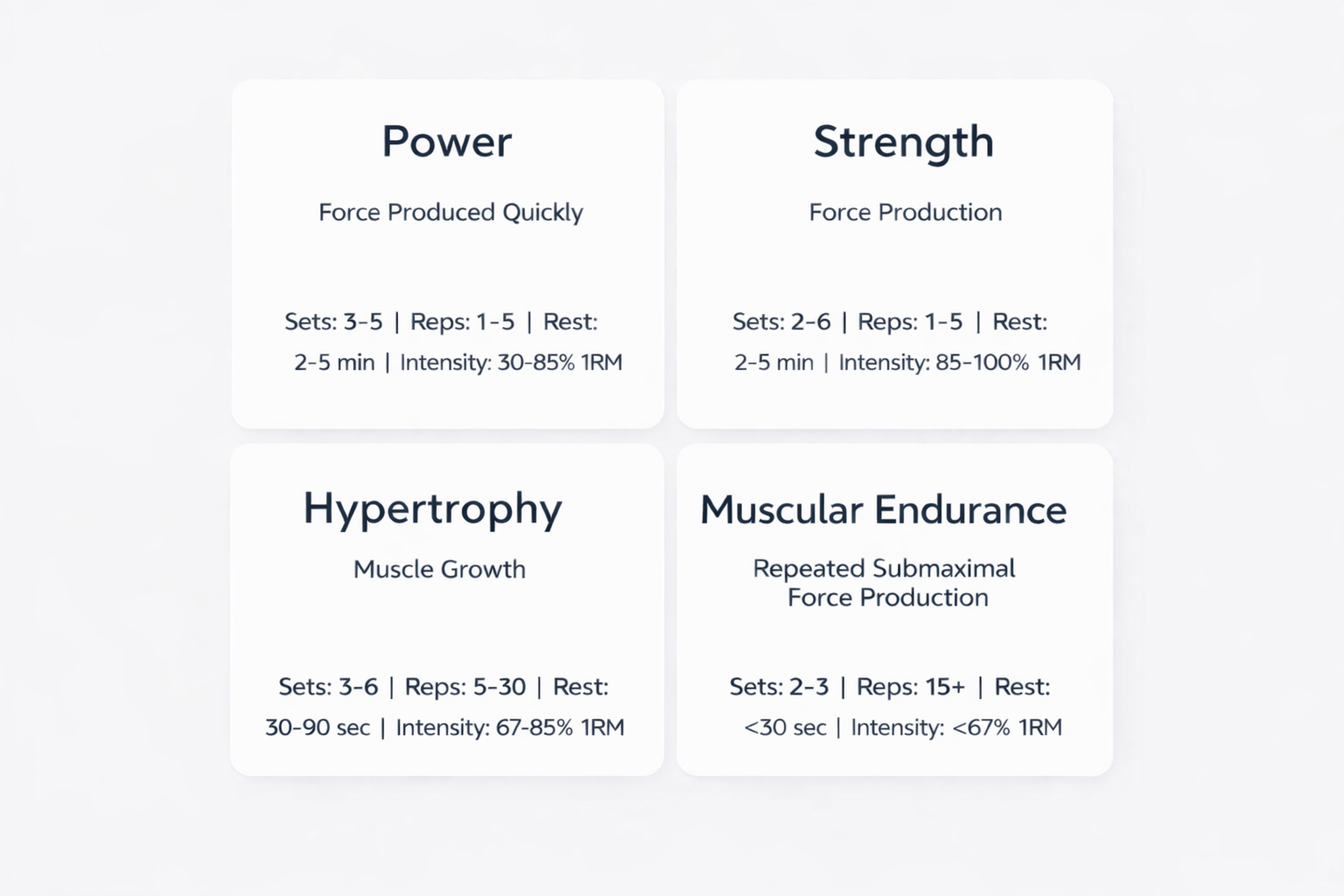
- Sets/Reps/Rest: 3-5 sets of 1-5 reps, with 2-5 minutes of complete rest between sets is optimal for power development. This long rest period ensures you aren't tired, so every set is a high-quality, explosive effort2.
- Frequency: This type of training focuses on making the connection between your brain and your muscles faster and more efficient, rather than simply tiring you out. Because it's less physically draining, you could safely incorporate it into your routine almost daily. However, you'll still see great results with just one or two power-focused workouts each week.
Strength
- Definition: Maximal strength is the peak force you can produce, regardless of speed. It's about how much raw weight you can move.
- Why It Matters: Moving heavy loads is a reality of the tactical world. Strength provides the raw capacity to manage those loads and makes you more resilient to injury. When your muscles and connective tissues are stronger, they can handle more. This doesn't just mean you can lift heavier things; it also makes you better at endurance activities like running and rucking. Every step you take uses a lower percentage of your total strength, so your body doesn't have to work as hard to perform the same amount of work.
- How to Train It: Like power, strength is driven by intensity, not volume.
- Driver: Intensity—lifting heavy weight—is what tells your body to get stronger.
- Intensity: 85% or more of your 1RM.
- Sets/Reps/Rest: 2-6 sets of 1-5 reps, with 2-5 minutes of rest to let your body fully recharge for the next heavy lift.
- Frequency: Like power, strength can be trained as much as almost daily, since it is not incredibly fatiguing. However, 2-3 times per week per muscle group is likely sufficient to maintain and improve strength.
- Exercise Selection: Focus on compound exercises that use multiple joints and muscles at once (e.g., Squats, Deadlifts, Bench Press, Overhead Press, Rows).
- Nuances: Strength, like power, is largely a skill of your nervous system. Your brain gets better at telling your muscles what to do. Think of it like this: your brain learns to call more muscle fibers into action, tell them to fire faster, and make them all work together smoothly as a team. This is why you can get much stronger without getting much bigger. More muscle increases your potential for strength, but a well-trained nervous system is what lets you use that potential.
Hypertrophy (Muscle Growth)
- Definition: Hypertrophy is simply the increase in the size of your individual muscle fibers, causing your muscles to grow larger.
- Why It Matters: Adequate muscle mass provides the foundation for strength and raises the ceiling for its development. It also distributes the strain of load carriage across more tissue, making any loaded task feel less demanding. For the tactical athlete, however, more is not always better. Too much muscle is heavy to carry around and requires more oxygen delivery, which can hold you back during long endurance events. The goal is to build a functional, effective amount of muscle, not necessarily the maximum amount possible.
- How to Train It: Unlike power and strength, muscle growth is primarily driven by your total training volume.
- Driver: Volume (Sets x Reps x Weight) is the key. You have to do enough total work to signal to your muscles that they need to grow bigger to handle the stress you are placing on them.
- Intensity/Reps: You can build muscle across a wide spectrum of repetition ranges (from 5 to 30), as long as the set is challenging and taken close to muscular failure (meaning you feel like you could only do 2-3 more reps or less if you had to). Muscle hypertrophy is also generally enhanced when exercises are performed through a full range of motion at any given joint. This generally occurs between 67-85% 1RM, but sometimes less depending on the repetition range. The 8-12 rep range is popular because it's a great middle ground for building muscle without the extreme mental fatigue of very high-rep sets.
- Sets/Rest: 3-6 sets per exercise, with shorter rest periods of 30-90 seconds. This shorter rest creates "metabolic stress"—the "burn" you feel—which is a key ingredient for growth.
- Frequency: Muscle tissue needs about 48-72 hours to repair and grow. Because of this, training the same muscle group hard more than 2 or 3 times per week is usually counterproductive.
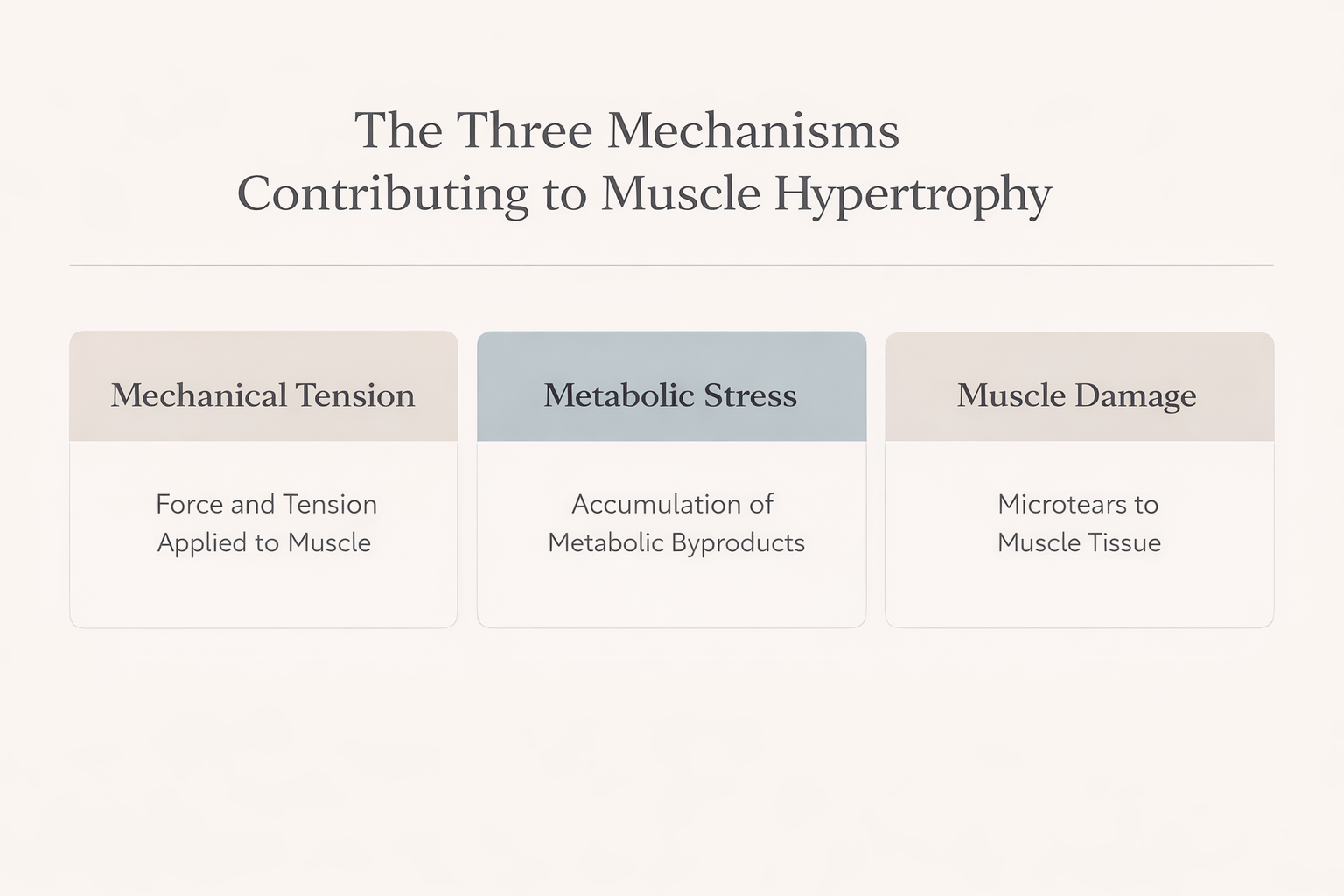
- Interesting Fact: Muscle growth is generally thought to be caused by three main things. First is Metabolic Stress, which is what causes the "burn" you feel when your muscles are working hard, due to the buildup of metabolic byproducts. Second is Mechanical Tension, which is the force and tension put on your muscles when you lift heavy weights. Finally, there's Muscle Damage, which refers to the tiny tears that occur in your muscles after a tough workout, signaling them to rebuild stronger3. This is summarized in figure 1 below.
- A Unique Tool: Blood Flow Restriction (BFR) training is an excellent tool that takes advantage of the "metabolic stress" mechanism of muscle growth. By using inflatable cuffs to safely reduce blood flow in your limbs, you can trigger muscle growth signals with very light weights. BFR is incredibly useful for staying strong while recovering from an injury or when traveling with limited equipment. Just remember the SAID principle: BFR is a great supplement, but it's no substitute for lifting heavy if your job demands it.
Muscular Endurance
- Definition: This is the ability of a muscle to perform a less-than-maximum effort repeatedly over time, like when you're holding a plank or running for long distances.
- Why It Matters: From rucking and running long distances to passing fitness tests that rely on max push-ups and sit-ups, the ability to resist fatigue and sustain output is essential.
- How to Train It: This adaptation is trained by pushing for more repetitions with lighter loads and very little rest.
- Driver: High repetition volume with short rest periods.
- Intensity/Reps: Under 67% of 1RM for 15+ repetitions.
- Sets/Rest: 2-3 sets with 30 seconds or less of rest between them.
- Frequency: 2-3x/week is probably ideal.
- The Strength Connection: Your maximal strength has a direct impact on your endurance. For an athlete who can bench press 200 pounds, a push-up is a relatively easy task, because it requires a low percentage of their maximum strength, so it is easier to train to do a lot of them. For an athlete with a 100-pound max bench, that same push-up requires a much higher percentage of their total strength, and they will fatigue quickly. Only by increasing maximum strength does your ceiling for better endurance improve. Don't neglect improving maximal strength. A summary of the adaptations discussed in this article are summarized in figure 2 below.
Conclusion
Power, Strength, Hypertrophy, and Muscular Endurance are interconnected pillars that support the structure of a resilient, effective, and durable tactical athlete. By understanding the different ways to train, you can move beyond simply "working out" and begin training with intelligence and purpose. A smart program for a tactical athlete will address all of these qualities, building a truly well-rounded and resilient operator.
References
- Marenzana, M., & De Ruiter, C. J. (2020). "The contribution of a reduction in maximal motor unit discharge rates to age-related loss of dynamic muscle strength." Journal of Applied Physiology.
- Haff, G. G., & Triplett, N. T. (Eds.). (2016). Essentials of strength training and conditioning (4th ed.). Human Kinetics
- Schoenfeld, B. J. (2010). "The mechanisms of muscle hypertrophy and their application to resistance training." Journal of Strength and Conditioning Research, 24(10), 2857-2872.
Schoenfeld, B. J., et al. (2017). "Strength and Hypertrophy Adaptations Between Low- vs. High-Load Resistance Training: A Systematic Review and Meta-analysis." Journal of Strength and Conditioning Research, 31(12), 3508-3523.