Why Muscle Matters
The Instrumental Role of Muscle and Strength in Tactical Performance and Long-Term Health
Introduction
We now turn our focus to a vital component of any high-performing athlete: skeletal muscle and strength.
This series will serve as a comprehensive guide to muscle and strength, providing the knowledge you need for sustainable, long-term performance. Today’s post, however, will focus on a single goal: convincing you why this topic is paramount. For tactical professionals, developing muscle and strength is essential for high-level performance; and for everyone, it is critical for a long, healthy, and independent life.
A Note on Terminology: Muscle vs. Strength
Throughout this series, we will frequently discuss both "skeletal muscle" and "strength." To avoid any confusion, it's important to clarify the distinction between these two related, but separate, concepts.
Your body has three types of muscle: cardiac (the heart), smooth (in your organs), and skeletal. Our focus here is exclusively on skeletal muscle, which is the physical, structural tissue responsible for movement and force production.
Strength, on the other hand, is the ability to produce that force. While the amount of skeletal muscle is a primary determinant of strength, it is not the only factor. Other factors such as your nervous system also play a crucial role in how effectively your body recruits and utilizes muscle fibers.
For the purpose of this introductory article, we will often discuss them in tandem because they are so closely linked. In future articles, we will explore the nuances between different qualities of performance, such as:
- Strength: The maximum force you can produce.
- Power: The ability to produce force quickly.
- Hypertrophy: The increase in the size of individual muscle cells.
- Muscular Endurance: The ability to sustain submaximal force over time.
Why Muscle is Mission-Critical
For the tactical athlete, the need for strength is self-evident. Every mission-essential task, from evacuating a casualty to scaling a wall or maneuvering with a heavy weapons system, is an expression of the ability to produce force. Without that ability, the mission is in jeopardy.
While a robust aerobic system is crucial for covering long distances and recovering from intense activity quickly, it is strength that allows you to perform the decisive actions required by your job. Great cardiovascular fitness alone is not enough for the tactical athlete; strength is what enables you to execute mission essential tasks. Cardiovascular fitness gets you to the fight and keeps you in it, but strength is what wins it.
Furthermore, many tactical endurance activities, such as loaded marches, are defined by the challenge of carrying external loads. This imposes a significant and constant strength demand that traditional aerobic exercise—like running, biking, or rowing—lacks. Simply being able to run quickly isn't enough, you need to have enough strength to move the load effectively for long distances. Simply put, without strength, you cannot be effective in your role. It is mission-critical.
Muscle’s Role in Healthy Aging
Beyond its importance in tactical performance, healthy skeletal muscle is a cornerstone of a long and vibrant life. This is true for both physiological and functional reasons.
Physiological Benefits
Physiologically, your muscles play a central role in your long-term health in two powerful ways:
First, when your muscles contract during exercise, they release powerful signaling molecules called myokines. These are chemical messengers that travel throughout your body, giving helpful instructions. Some of these myokines exert anti-inflammatory effects, fighting the chronic, low-level inflammation that is a likely contributor to many age-related diseases. Others send signals that improve the function of your brain, liver, and other organs. In essence, by working your muscles, you are triggering a wave of positive effects throughout your body1.
Second, muscle is a primary tool for blood sugar management. The simplest way to think of skeletal muscle is as a "glucose reservoir." When you eat carbohydrates, they break down into sugar (glucose) in your blood, and that sugar needs a place to go. Your muscle tissue acts like a massive sponge, ready to soak up that glucose for energy. This is especially true when the muscle tissue contracts during exercise and physical activity. The more healthy muscle you have, the bigger your "sponge" and the more effective your body can be at keeping blood sugar levels stable. This is incredibly important, as poorly controlled blood sugar is what leads to type 2 diabetes and likely contributes to other serious conditions like heart disease and dementia2.
These examples make it clear that having healthy muscle isn't just about strength or appearance. It is a vital organ that actively works to protect your systemic, long-term health, setting you up for more high-quality, functional years.
A Note on My Perspective
As a physical therapist, my professional focus is on the practical application of movement and exercise. While the topics above are grounded in deep and complex physiology, my goal here is not to provide an exhaustive academic review. Instead, my aim is designed to give you a solid, foundational understanding of why muscle is so critical before we dive into the actionable strategies for building and maintaining it for life.
Functional Benefits
True longevity has two components: the length of your life (lifespan) and its quality (healthspan). It’s not just about delaying or preventing disease; it’s about having the physical capacity to do what matters to you for as long as possible.
This is where strength becomes practical. Maintaining strength allows you to participate in the activities you love—whether it's playing on the floor with your grandchildren or enjoying a round of golf—for a greater portion of your life. On a more fundamental level, strength is what allows you to perform basic daily tasks independently.
While a loss of muscle mass and strength to some degree is inevitable as we age, the steep decline in strength and function that many people experience is not. A large part of this accelerated loss is directly linked to the increasingly sedentary lifestyles that often accompany aging3.
This distinction is powerful because it puts control back in our hands. Consistent strength training can substantially delay the onset of decline and then slow its rate of progression. It directly counteracts the muscle loss from inactivity while also dampening the rate of age-related decline. Furthermore, by building a high capacity for strength earlier in life, we create a vital reserve. This "cushion" ensures that even with the inevitable minor losses, we maintain the physical capability required for a long, active, and independent life.
Preventing Falls and Fractures
A hidden but critical benefit of strength as we age is fall prevention. For an older person, a fall is not a minor inconvenience; it can be a catastrophic, life-altering event.
Falls in an elderly population frequently lead to fracture, especially of the hip. In an elderly population, a hip fracture can be a death sentence. Studies show that approximately 20% of seniors who break a hip die within one year4.
While other factors like reaction time, balance, and vision contribute to falls risk, strength is a primary line of defense. It improves your ability to "catch yourself" during a stumble and provides the power to resist the fall in the first place.
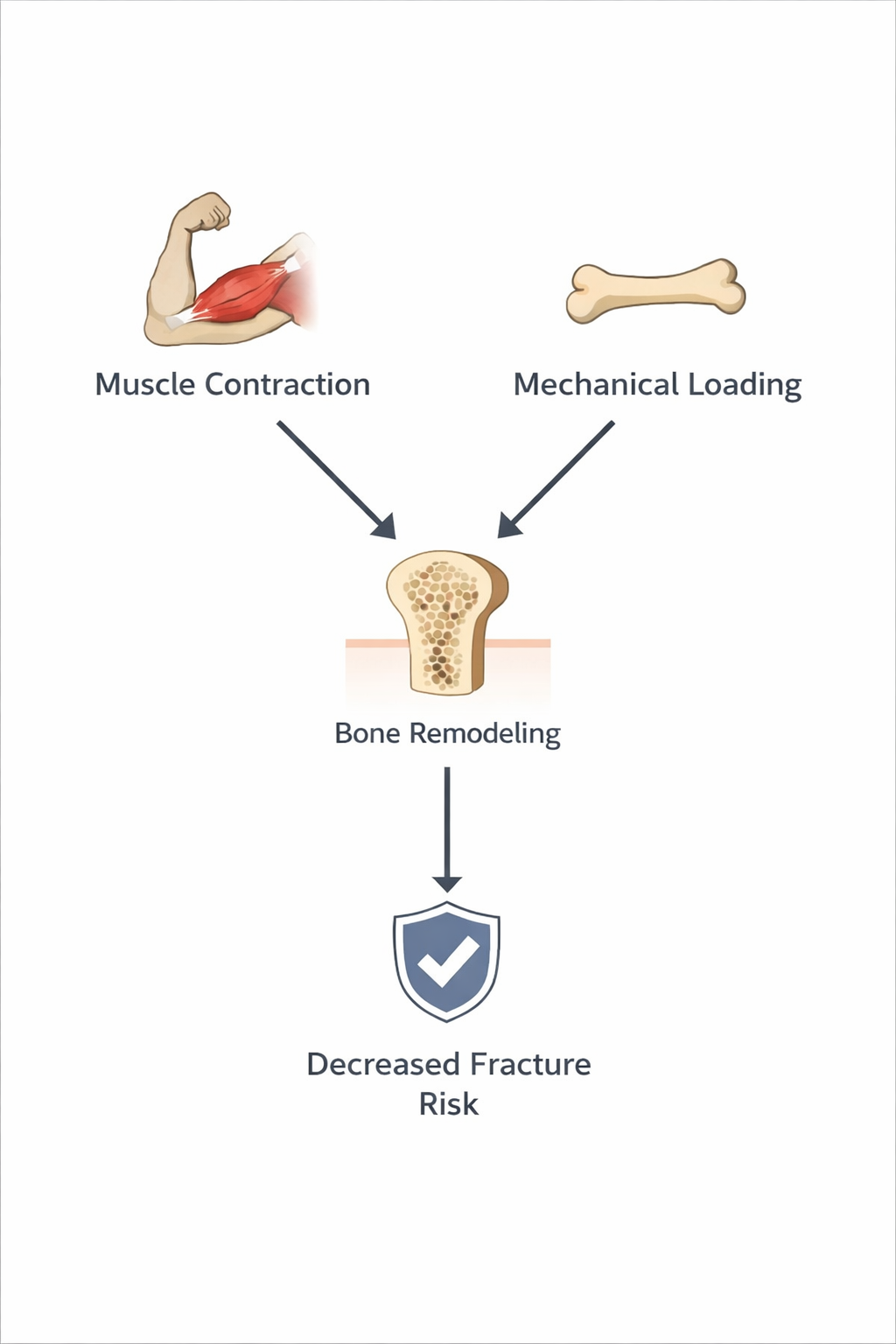
Importantly, resistance training also targets the underlying issue by improving bone mineral density. Mechanical loading during resistance exercise stimulates bone-forming cells to build stronger, denser bones. When muscle contracts, it pulls on bone—creating a signal that tells your skeleton it needs to adapt.
Together, muscular contraction and mechanical loading converge to drive bone remodeling, ultimately reducing fracture risk (Figure 1). With stronger bones, this means that if a fall does occur, a fracture is less likely. This direct link between muscular strength, fall prevention, and skeletal health helps explain why higher strength is consistently associated with a lower risk of all-cause mortality6.
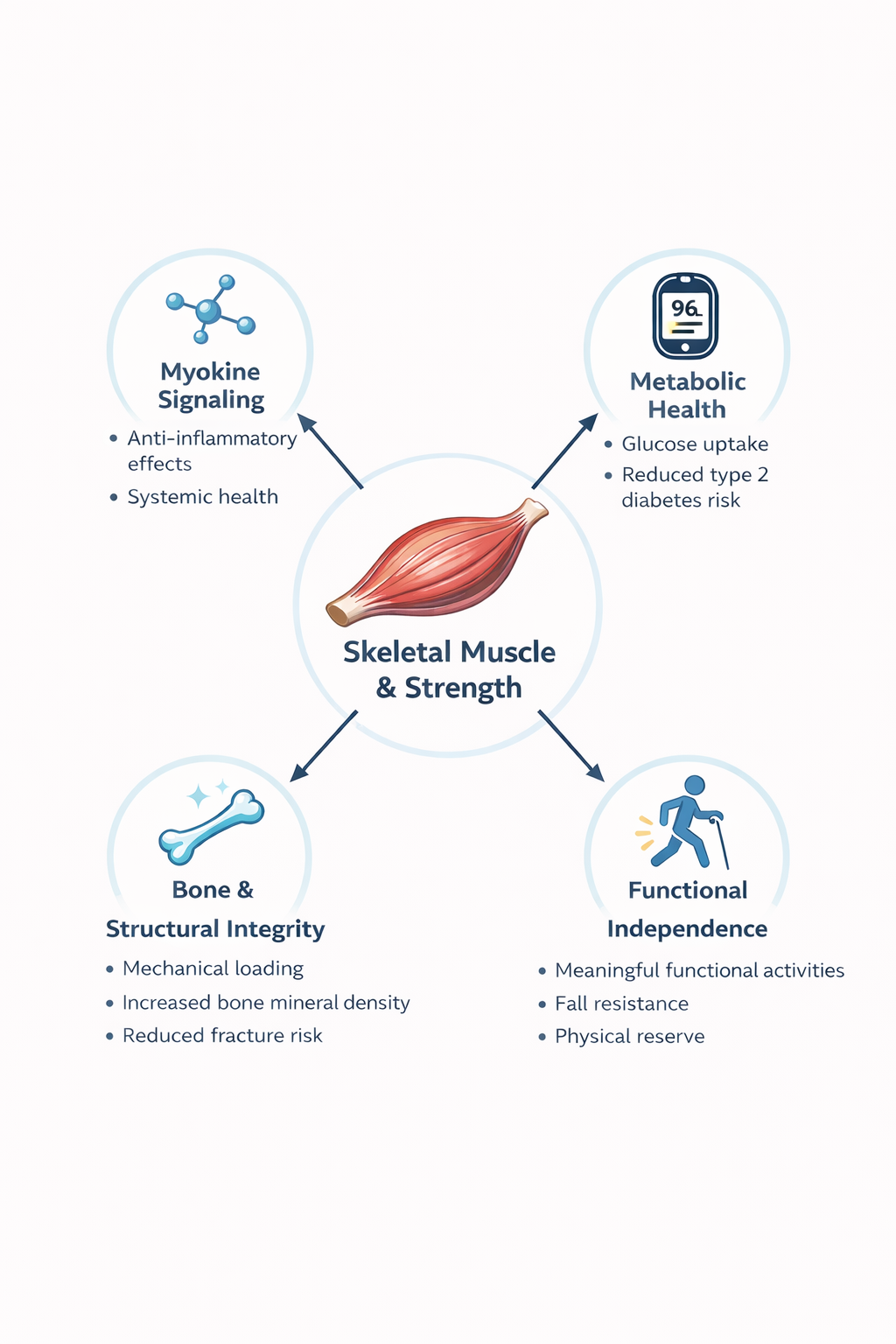
All of the mechanisms discussed above—myokine signaling, glucose regulation, functional capacity, and bone health—are downstream results of skeletal muscle health and strength. Figure 2 illustrates this relationship.
A Note on Research Interpretation
A common mistake is to misinterpret study results literally. For example, many studies show a powerful correlation between grip strength and lower mortality rates. This does not mean the optimal strategy is to train your grip obsessively.
In this context, grip strength serves as a proxy—an easily measured indicator of a person's overall, whole-body strength. A strong grip is simply a sign of a strong, resilient body. For optimal results and true longevity, you need more than a strong grip. The goal is a balanced, whole-body strength training program.
The Strategy
As discussed previously, some decline in muscle mass and strength is inevitable as we age. While some loss is unavoidable, when the decline begins and the rate of this decline is something we can control. This reality gives us a clear, two-part strategy for preserving function long-term:
- Build a Higher Peak: The more muscle and strength you build early in life, the larger your physiological "buffer" will be. Starting from a higher peak ensures that the inevitable downward slope of aging is less likely to drop below the critical threshold for independence (e.g., the strength to get out of a chair, carry groceries, or prevent a fall).
- Slow the Decline: Consistent, lifelong resistance training is the single most effective tool we have to slow this process. It acts as a powerful brake on age-related muscle and strength loss, preserving your physical capacity for as long as possible.
By combining these two principles, you are not stopping aging, but you are taking direct control over your physical function and quality of life for decades to come.
The Tactical Professional’s Advantage
As we've established, high levels of strength are not optional for the effective tactical professional; it is a prerequisite for success. This demanding reality creates a strategic advantage for building lifelong health.
Most tactical professionals are in their 20s and 30s—the most opportune years for building a foundation of strength and muscle. While others in the civilian world may have sedentary occupations, the tactical profession requires engagement in the very activities that build long-term resilience.
This creates a powerful "two-for-one" opportunity. Strength training serves as a direct investment in both your present and your future. You're not only enhancing your job performance, but you are also fundamentally setting the stage for a more capable and independent future.
The Enemy of Longevity: Poor Training Methods
For the tactical professional, the greatest threat to lifelong muscular health is not a lack of effort, but the application of that effort in a way that is unintelligent and unsustainable. The unique opportunity to build a high peak of function can easily backfire.
Here is a common, destructive cycle that many tactical athletes face:
- An athlete trains hard, but with poor programming or technique.
- This leads to preventable injury.
- They are forced to stop training, or can no longer train with enough intensity to make progress.
- They form the incorrect conclusion that resistance training itself is inherently dangerous and abandon it, missing out on its profound, lifelong benefits.
The physiological benefits of strength only accrue with consistency over decades. Ineffective training methods are the enemy of consistency. The truth is, strength training isn't dangerous—unintelligent training is.
Performed with good technique and appropriately managed volume, it is an incredibly powerful tool for building resilience. This series is designed to provide you with the framework to train intelligently, ensuring your hard work builds you up for a lifetime of high function, rather than tears you down.
Resist the Urge to Specialize
While strength is a cornerstone, the goal for a tactical athlete is not to maximize it at all costs. The pursuit of absolute, elite-level strength—the domain of a competitive powerlifter—is a strategic error for a tactical professional. This path becomes counterproductive because it demands a level of specialization that compromises other critical areas.
Squeezing out every ounce of your strength potential requires immense training volume and recovery resources. This inevitably:
- Takes time and energy away from essential cardiovascular training.
- Drives up training volume to a point that increases injury risk and compromises readiness, especially if you attempt to train cardiovascular fitness at a high level simultaneously.
The goal is not to be a world-class powerlifter; it is to be a durable, resilient, and tactically effective operator. Your aim is to achieve a high level of competency across all necessary domains—to be very strong and have robust endurance.
Looking Forward
This article laid the foundation by answering "why." You now understand that muscle is not just for performance—it is a critical organ for mission readiness and a non-negotiable component of a long, healthy life.
With the "why" firmly established, our focus now shifts to "how." In the articles to come, we will provide the blueprint for building and maintaining your muscular function sustainably, equipping you for a durable career and a capable life long after it.
References
- Pedersen BK, Febbraio MA. Muscles, exercise and obesity: skeletal muscle as a secretory organ. Nat Rev Endocrinol. 2012;8(8):457-465. doi:10.1038/nrendo.2012.49
- Merz KE, Thurmond DC. Role of skeletal muscle in insulin resistance and glucose uptake. Compr Physiol. 2020;10(3):785-809. doi:10.1002/cphy.c190029
- Mitchell WK, Williams J, Atherton P, Larvin M, Lund J, Narici M. Sarcopenia, dynapenia, and the impact of advancing age on human skeletal muscle size and strength; a quantitative review. Front Physiol. 2012;3:260. doi:10.3389/fphys.2012.00260.
- Downey C, Kelly M, Quinlan JF. Changing trends in the mortality rate at 1-year post hip fracture - a systematic review. World J Orthop. 2019;10(3):166-175. doi:10.5312/wjo.v10.i3.166.
- Hong AR, Kim SW. Effects of resistance exercise on bone health. Endocrinol Metab (Seoul). 2018;33(4):435-444. doi:10.3803/EnM.2018.33.4.435.
- García-Hermoso A, Cavero-Redondo I, Ramírez-Vélez R, et al. Muscular strength as a predictor of all-cause mortality in an apparently healthy population: a systematic review and meta-analysis of data from approximately 2 million men and women. Arch Phys Med Rehabil. 2018;99(10):2100-2113.e5. doi:10.1016/j.apmr.2018.03.024