
Pain Science in Practice

How to Prevent Acute Issues from becoming Chronic
Introduction
Last month, in "Making Sense of Pain," I laid out a framework for thinking about training aches: pain is information, pain doesn't always equal damage, and the smartest response usually lives somewhere between "push through it" and "shut it all down." This article is all about practical application—and its implications for long-term health and operational capability.
This article discusses two different patients. Both hurt their backs. Both had, more or less, the same injury. But they had very different long-term outcomes and recovery timelines—and the single biggest factor wasn't the tissue injury itself.
I've changed the details enough to protect privacy, but cases like these are all too common in Military medicine.
A Quick Note Before We Start
Everything here is about the common, non-traumatic, "my back went" kind of episode. It is not about true medical emergencies. If you've got significant trauma, can't bear weight, or have progressive numbness, true weakness, or new bladder or bowel changes, that is the RED category from our decision framework. Stop and get evaluated immediately. This article assumes we've already ruled those out.
Case One: The One That Went Right
Staff Sergeant "A" came to see me two days after tweaking his back mid-deadlift. He felt a sharp pain in his low back on his third rep, racked the bar, and spent the rest of the day hobbling around. By the time he saw me, he was guarded, nervous, and asking the question everyone asks: "Did I slip a disc?"
Here is what made his story a short one:
- First, we screened for the serious issues. No red flags. No trauma, no neurological symptoms, and no reason to think anything sinister was going on. That matters, because it meant we did not need to order imaging. For run-of-the-mill low back pain without red flags, imaging doesn't change what we do, and it frequently finds "problems" that were never actually the problem1.
- Second, we applied pain science directly. I told him what the evidence says plainly: the vast majority of these episodes settle down, staying active beats resting in bed, and hurting is not the same as harming2,3. Reassurance and education are critical interventions for acute low back pain, and they measurably reduce a person's odds of bouncing back into the clinic over the next year3.
- Third, we modified instead of eliminated. He didn't stop training. We pulled back on deadlifting for a bit, kept him moving with tolerable variations, dialed the load down, and built it back up over the following couple of weeks. This tracks with what we know about the natural history of back pain: most acute episodes improve substantially within about six weeks3.
That's it. It's almost boring. And that is exactly the point—a well-managed acute back is supposed to be boring.
Case Two: The One That Didn't Have To Go That Way
Sergeant First Class "B" had nearly the same injury. Different timeline, though. He didn't get evaluated immediately. He did what a lot of people do: he toughed it out, and when it didn't magically resolve, he eventually landed in a primary care office weeks later.
The provider he saw was well-meaning. But that provider wasn't fluent in pain science or in how common "abnormal" scans are in people who feel totally fine. So an MRI got ordered, the MRI came back showing degenerative changes and a disc bulge, and SFC B was told, in effect, that his back was damaged and that he needed to "be careful"—that certain movements were dangerous.
Now, here is the thing I spend a huge chunk of my week undoing: those scan findings were unlikely to be a problem. Degenerative changes and disc bulges are astonishingly common in people with no pain at all. In large population studies, degenerative findings show up on MRI in roughly three out of four adults without any back pain, and that number climbs even higher with age3. These are, as I like to call them, wrinkles on the inside. Expected. Often meaningless.
But SFC B didn't know that. All he heard was "damaged" and "dangerous." So he did exactly what a reasonable person does when an authority figure tells them movement might wreck their spine: he stopped moving.
This is fear avoidance, and it's one of the most reliable ways to turn a short-term problem into a long-term one. Erroneous beliefs that specific movements are harmful are common in patients with back pain4. The fear-avoidance cycle is well established: misinterpreting pain as a sign of harm drives avoidance, which fuels disability, deconditioning, and more pain in a self-perpetuating loop2.
The pain was 100% real—it always is—but now it was being amplified and maintained by deconditioning, hypervigilance, and a genuine belief that his back was fragile.
By the time SFC B got to me, months had passed. I wasn't treating an acute back anymore. I was treating a chronic pain experience wrapped around a story about a broken spine.
The Long Road Back
Getting SFC B to the same place SSG A reached in a month took the better part of half a year. And it took a fundamentally different kind of work.
We started with education. We looked at the imaging-in-pain-free-people data together. We talked about why hurt isn't harm and why his back was far more robust than he'd been led to believe. Changing that story is not fluff. Research shows that combining pain science education with exercise produces significantly larger improvements in pain, disability, and—critically—fear of movement than exercise alone5,6.
Then we rebuilt, gradually. We used graded exposure—deliberately and progressively reintroducing the very movements he had come to fear, in doses he could handle, proving to his nervous system over and over again that they were safe. Load crept up. Confidence crept up with it. The fear, which was really the engine of the whole thing, slowly lost its fuel.
He got there. Mostly. And that's the honest, uncomfortable footnote: not everyone fully does. The further down the chronic road someone travels, the harder and less certain the trip back becomes. SSG A and SFC B started at the same trailhead. One took a short, well-marked path. The other took a months-long detour—and it was largely avoidable.
What Actually Separated Them?
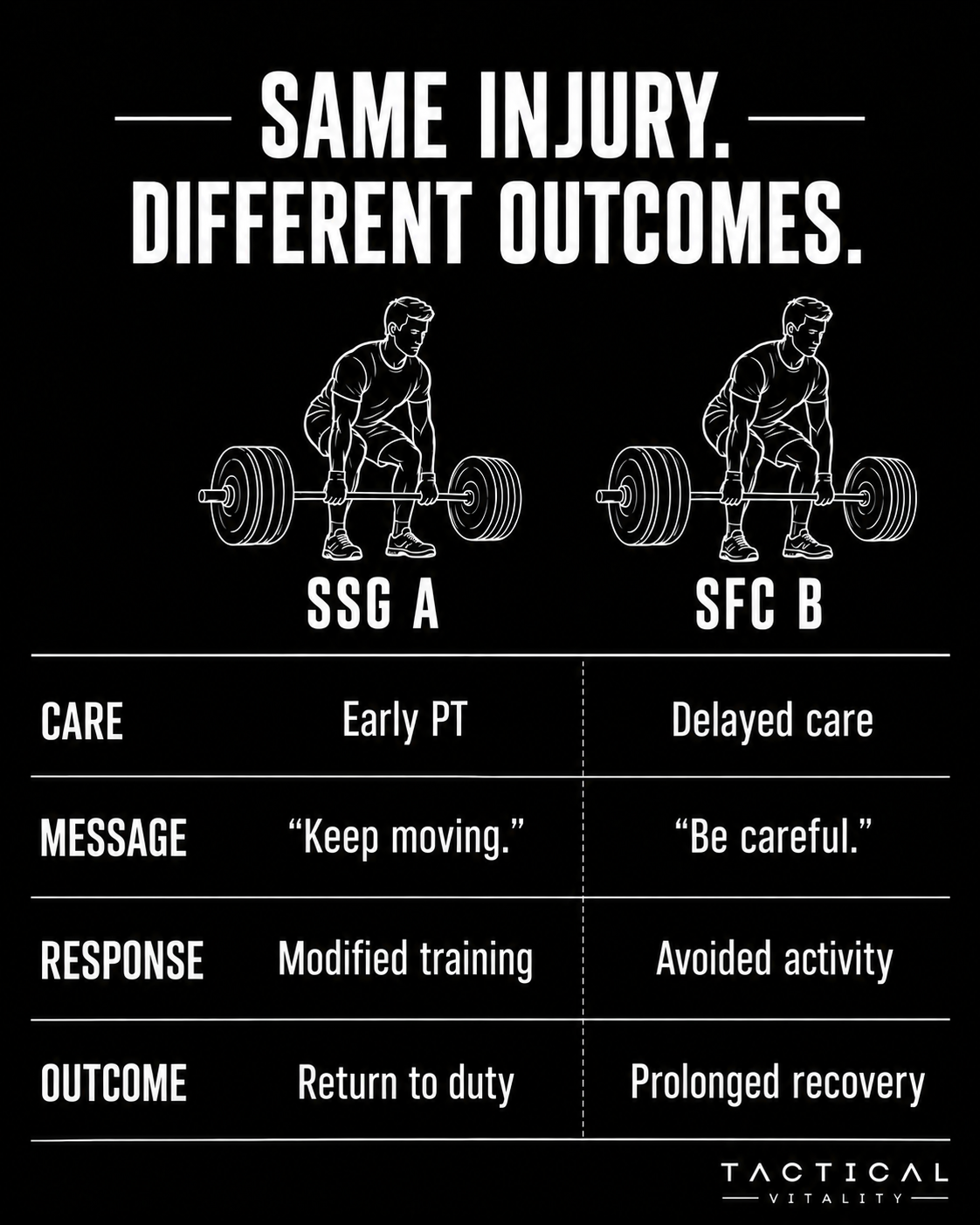
SSG A was told: this is common, you're not fragile, keep moving, we'll modify and rebuild. SFC B was told: something's damaged, be careful, movement is a threat. Same injury. Opposite application. Opposite long-term outcomes (figure 1).
A quick caveat: these two stories are simplified on purpose. Real patients are messier than a clean side-by-side. Whether someone spirals into fear avoidance depends on a lot more than one conversation—prior pain experiences, baseline anxiety and stress, mood, sleep, coping style, workplace and family pressures, and yes, individual temperament all play a role. Some people are simply more prone to these patterns than others, and a great initial encounter isn't an absolute guarantee against them.
I've painted these cases as near-opposites to make a point, not because every back injury sorts neatly into "A" or "B." But here is what doesn't change no matter how messy the individual is: early, accurate education and intelligent initial intervention consistently tilt long-term outcomes in the right direction. It won't override every single risk factor, but it is one of the few levers we can reliably pull—and it's free.
Long-Term Implications for Tactical Athletes
It would be easy to write off SFC B's story as one guy having a rough year. But zoom out, and the "Case Two" pattern has consequences that ripple well past a single episode—for the individual and for operational readiness.
Start with the readiness math. Low back pain is already the single most common medical encounter in the U.S. military, year after year7. And when a new episode turns chronic, the cost isn't distributed evenly—it concentrates. In active duty members newly presenting with low back pain, those who develop chronic symptoms account for the overwhelming majority of clinical encounters, imaging, lost duty days, and long-term costs. Spine injuries in service members are a persistent, costly drain on readiness, not because the injuries themselves are structurally catastrophic, but because fear and pain linger.
Then there's the quality of the outcome, even when things do resolve. Getting "better" after months of chronicity is rarely the same clean result as SSG A's month-long detour. Recurrent and chronic back pain in service members travels with higher rates of depression, anxiety, and worse overall quality of life8. And having a back pain episode significant enough to sideline you during military service strongly predicts more back pain years later in civilian life.
But here is the implication I think matters most for our community, and it is the hardest one to put a number on. Fear-avoidant beliefs don't stay politely contained to the injury that created them. They fundamentally change how you approach movement going forward. Fear of movement is linked to lower physical activity, and it drives the classic downstream chain: guarding, disuse, and deconditioning9. In injured athletes specifically, higher fear avoidance independently predicts worse physical function—it helps explain why two people with the same structural injury can end up in completely different places.
For a tactical athlete, that is the real long-term tax. If some part of you has quietly decided that loading your spine is dangerous, you won't train it hard. If you won't train it hard, you can't build the strength and capacity the job demands—or the durability that lets you keep doing the things you actually value, on duty and off. The injury heals; the belief lingers, and it slowly caps your physical ceiling.
That is the version of Case Two that never shows up in a database: not the guy who is medically discharged, but the guy who is quietly, permanently performing at 70% because somewhere along the way he was taught to be afraid of his own back.
That is why initial management is worth getting right. It's not only about resolving one episode faster. It's about protecting a career's worth of capability.
The Takeaways
- Rule out the emergencies. If you've got RED-flag signs (progressive numbness, bowel/bladder changes, trauma, inability to bear weight), get evaluated immediately. Otherwise, take a deep breath. You are not broken.
- Be skeptical of scary scan interpretations. A bulge or "degeneration" on an MRI is often just a wrinkle on the inside—an expected sign of an active life, not a sentence of permanent damage. If someone hands you a frightening imaging report without connecting it to your actual function, seek a second opinion.
- Keep moving, but modify. This is the same middle path from our decision framework. Reduce, adjust, and rebuild—don't slam on the brakes entirely.
- Mind the story you tell yourself. The belief that your body is fragile is, itself, one of the strongest predictors of a long, delayed recovery.
The goal, rather than completely avoiding pain, should be to lead a capable live that can sustained. The road to capability is a whole lot shorter, and a whole lot longer-lasting, when early management points you down the right trajectory.
References
- Association of Lumbar MRI Findings With Current and Future Back Pain in a Population-Based Cohort Study (Spine)
- Low Back Pain (Lancet)
- Nonspecific Low Back Pain (NEJM)
- Low Back Pain (JAMA)
- Short-Term Impact of Combining Pain Neuroscience Education With Exercise for Chronic Musculoskeletal Pain (Pain)
- Reductions in Kinesiophobia and Distress After Pain Neuroscience Education and Exercise Lead to Favourable Outcomes (Pain)
- Low Back Pain During Military Service Predicts Low Back Pain Later in Life (PLoS One)
- Evidence-Based Clinical Guidelines For Multidisciplinary Spine Care (American Academy of Pain Medicine)
- Relationship Between Fear of Movement and Physical Activity in Patients with Pain Conditions (Physical Therapy)