
Heart Rate Variability Explained
A Tactical Athlete's Tool for Recovery and Readiness
Introduction
In our last post, we explored the critical concepts of stress and resilience, focusing on how to ensure stress leads to growth rather than breakdown. But how can we get a more objective look at how our body is handling this balance? How can we better understand our capacity for resilience?
One potential tool is Heart Rate Variability (HRV). While by no means a requirement for a healthy career, understanding HRV can be like having an inside view of your body's command center. It’s not about fixating on daily numbers, but about gaining a deeper awareness of your body's recovery, readiness, and overall capacity to perform under pressure. For the tactical athlete looking to add another layer of insight to their training, understanding this metric can be a powerful asset.
Your Body's Command Center: The Autonomic Nervous System
To understand HRV, we first need to look at the system that controls it: the Autonomic Nervous System (ANS). This is the "automatic" part of your nervous system, regulating vital functions like heart rate, breathing, and digestion without your conscious input. The ANS has two main branches that act like a gas pedal and a brake.
The Sympathetic Nervous System (SNS): This is your "fight-or-flight" system—the gas pedal. When you face a significant stressor, like an intense workout or a demanding mission, the SNS kicks in, accelerating your heart rate and mobilizing energy to prepare you for action.
The Parasympathetic Nervous System (PNS): This is your "rest-and-digest" system—the brake. The PNS is responsible for recovery and long-term rebuilding. It slows the heart rate and promotes relaxation, allowing your body to repair and adapt.
It’s crucial to understand that neither branch is "good" or "bad." A tactical athlete
absolutely needs a powerful sympathetic response to perform. The ability to "get up" for a challenge is non-negotiable. However, true resilience isn’t just about having a powerful gas pedal; it's about having incredibly effective brakes. For optimal health and recovery, we generally want the parasympathetic system to be the dominant force during periods of rest.
The Vagus Nerve: Your Master Brake Pedal
The primary driver of your parasympathetic "braking" system is the vagus nerve. Think of this massive nerve as a superhighway connecting your brain to your vital organs, especially your heart. When your brain perceives it's safe to relax, it sends signals down the vagus nerve to slow the heart. The stronger this "vagal tone" is, the more efficiently you can shift from a state of high alert back to one of recovery. This ability to rapidly down-regulate is the very essence of a resilient nervous system.
The Link: How Vagal Tone Creates Heart Rate Variability
This is where it all comes together. Your heart doesn’t beat like a metronome. Even if your resting heart rate is 60 beats per minute, the time between each beat isn't exactly one second. It might be 0.9 seconds, then 1.15 seconds, then 0.98 seconds. This small but significant beat-to-beat variation is Heart Rate Variability.
This variability is directly created by the constant, healthy push-and-pull between your sympathetic (accelerator) and parasympathetic (brake) systems1. A healthy, resilient system is characterized by a strong vagal influence, which creates a larger, more pronounced variation between heartbeats.
Therefore, a simple way to think about the link is: Higher HRV generally reflects greater parasympathetic activity, which is an indicator of a more resilient and recovered state. A high HRV suggests your nervous system is responsive and has the resources to handle more stress. A chronically low HRV can suggest that your system is stuck in "go" mode and is struggling to recover.
Why HRV Matters for Tactical Performance
So what does this mean in practical terms for a tactical athlete?
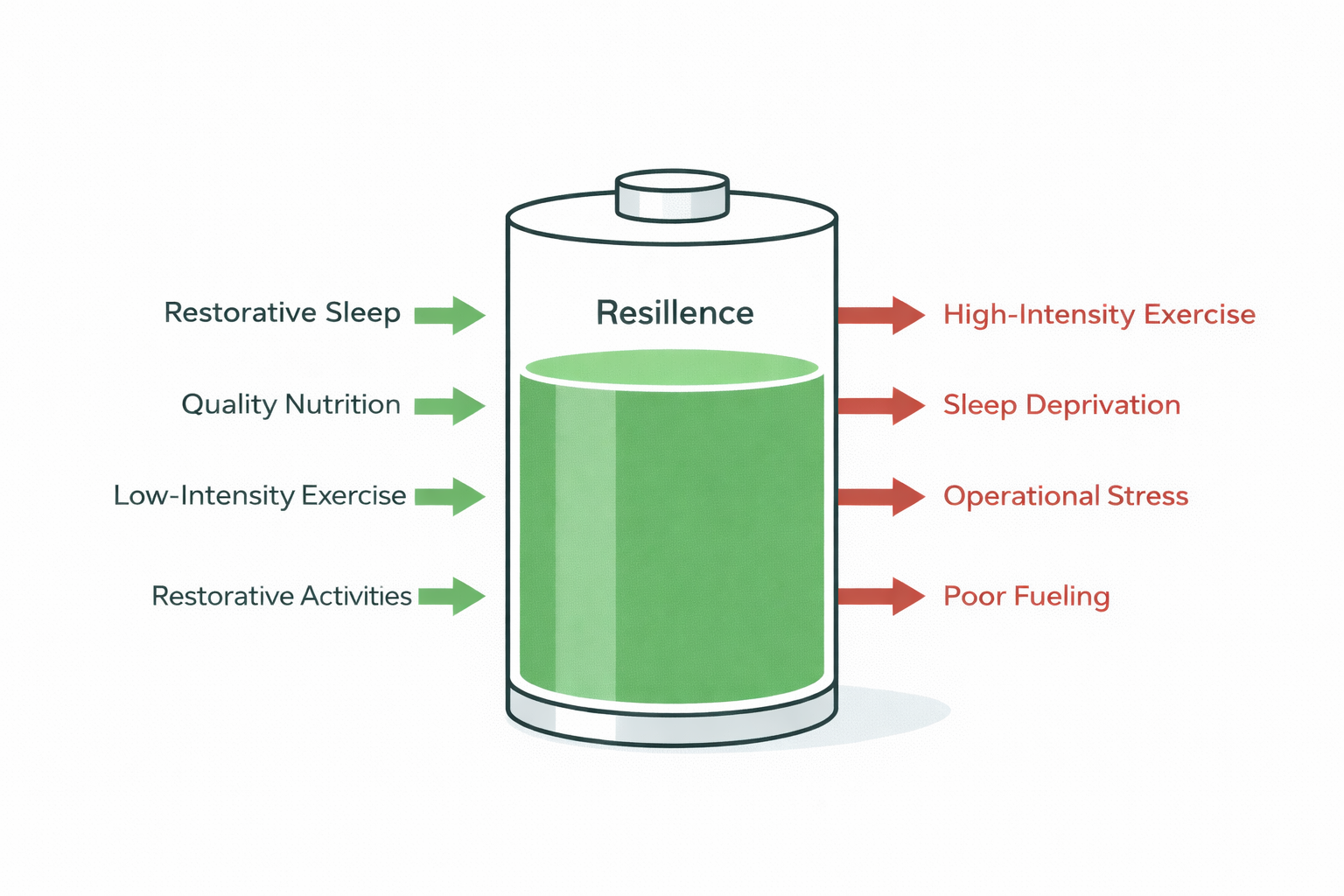
A useful way to think about this is through the lens of a stress battery. Your body has a finite amount of physiological and cognitive capacity available at any given time. Every stressor—hard training sessions, sleep deprivation, operational demands, psychological stress, or inadequate fueling—draws charge from that battery. Recovery inputs, such as restorative sleep, adequate nutrition, low-intensity movement, and intentional recovery practices, help recharge it.
Figure 1 provides a visual representation of this concept. The battery reflects your available stress capacity, with green inputs contributing to restoration and red outputs representing common stressors that drain it. The fill level of the battery represents short-term readiness, not long-term fitness.
This is where heart rate variability (HRV) becomes useful. HRV can be thought of as a rough indicator of how much charge remains in your stress battery. A meaningful drop below your normal baseline may signal that your system is under strain—specifically, that parasympathetic activity is suppressed and your physiological “brakes” are struggling to keep up with cumulative stress.
Consider a realistic scenario: you have a physically demanding training session planned, but you were up most of the night on a call-out. The following morning, you’re expected to be mentally sharp for a critical briefing. In this context, performance during that briefing depends less on motivation or toughness and more on whether sufficient cognitive and physiological resources are available.
A low HRV reading in this situation doesn’t mean you are weak or detrained. It suggests that your stress battery is already depleted. Pushing through another high-intensity session under these conditions risks further draining capacity when it may be needed elsewhere. Opting instead for a lighter, recovery-focused session isn’t being soft—it’s being strategic. It preserves readiness for tasks that matter most and supports long-term performance rather than short-term output.
Key Factors That Influence Your HRV
There are several factors that influence HRV:
- Aerobic Fitness: Building a robust aerobic system is the number one thing you can do to fundamentally improve your HRV in the long-term2. A strong cardiovascular system enhances vagal tone, making your heart and nervous system more resilient.
- Lifestyle Factors: Your Heart Rate Variability is directly affected by your sleep quality, physical training load, and mental stress. Managing these factors effectively can lead to greater resilience in your daily life.
- Genetics: It's important to note that genetics play a significant role in your HRV baseline. Your score is unique to you.
A Note on Values: Trends Over Absolutes
If you decide to explore HRV, it’s easy to get fixated on the daily numbers or to compare your score to others. Avoid this trap. Hyper-fixation on data can become just another stressor. There are no universally "good" or "bad" HRV scores, as values vary significantly based on age, genetics, and fitness3.
The real power of HRV, should you choose to use it, lies in tracking your personal trends over time. Don't overreact to a single low score. Instead, observe your weekly and monthly averages. Is your baseline trending upward as your fitness improves? Does it dip predictably after intense training blocks and then rebound higher? This long-term view provides the most valuable insight, offering clues about your adaptation and resilience
without creating daily anxiety over one number.
How to Measure HRV
If you decide to track your HRV, accuracy and consistency are key. Here are the tools and best practices to get reliable data:
The Gold Standard: Chest Straps. For the highest accuracy, a chest strap heart rate monitor is the best option. These devices use electrocardiography (ECG) to directly measure the heart's electrical signals, providing the most precise beat-to-beat data4.
The Convenient Alternative: Optical Sensors. Many devices, including watches, armbands, and rings, use optical sensors (photoplethysmography or PPG) to estimate HRV by measuring blood flow. While incredibly convenient, their accuracy can be affected by factors like device fit, skin tone, and movement. For optical measurements, armbands tend to be more reliable than wrist-based devices.
The Protocol: Consistency Is Everything. Regardless of the device you use, a consistent routine is the most critical factor for gathering useful data. The best practice is to take your measurement first thing in the morning, ideally within 10-30 minutes of waking up. Measure in the same position every day (sitting up is often recommended for athletes) and try to remain still and breathe naturally for the duration of the 1-5 minute reading. This minimizes outside variables and ensures the changes you see are a true reflection of your physiological state.
Conclusion
Heart Rate Variability is not a pass/fail test. It is simply a tool that provides a window into your body's ability to handle stress and recover. For the tactical athlete, it offers a way to listen to your body more objectively, helping you train smarter, recover more effectively, and build a truly resilient system capable of sustaining high performance across a lifetime. It is one of many tools in your toolbox to help you own your health and build a long, durable career.
References
- Sztajzel, J. (2004). Heart rate variability: a noninvasive electrocardiographic method to measure the autonomic nervous system. Swiss medical weekly, 134(35-36), 514-522.
- Manresa-Rocamora, A., Sarabia, J. M., Javaloyes, A., Flatt, A. A., & Moya-Ramón, M. (2021). Heart Rate Variability-Guided Training for Enhancing Cardiac-Vagal Modulation, Aerobic Fitness, and Endurance Performance: A Methodological Systematic Review with Meta-Analysis. International journal of environmental research and public health, 18(19), 10299.
- Shaffer, F., & Ginsberg, J. P. (2017). An overview of heart rate variability metrics and norms. Frontiers in public health, 5, 258.
- Plews, D. J., Scott, B., Altini, M., Wood, M., Kilding, A. E., & Laursen, P. B. (2017). Comparison of heart-rate-variability recording with smartphone photoplethysmography, polar H7 chest strap, and electrocardiography. International journal of sports physiology and performance, 12(10), 1324-1328.