Developing Range: Training for the Uncertain Demands of Tactical Performance
Why Broad Capability Drives Tactical Performance and Long-Term Health
Training for Uncertainty
Tactical professionals—soldiers, firefighters, law enforcement officers, and emergency responders—train for a world defined by uncertainty. Unlike traditional athletes who prepare for fixed events in controlled environments, tactical athletes operate in unpredictable settings where the task, timing, and intensity are difficult to predict.
That might mean dragging a teammate to safety, sprinting in full gear, rucking long distances under load, or climbing and breaching obstacles. These are just a few examples—but the key point is this: tactical demands are unpredictable, and the possibilities are wide-ranging.
Despite that variability, three key demands tend to be consistent across the board:
- Sustained movements, often under load
- Periods of high force output
- Skill execution and decision-making under stress
This is by no means an exhaustive list—but it gives us a solid foundation to work from.
To meet these demands, tactical athletes don’t need to specialize—they need to perform well across a wide spectrum of challenges. What they need is Range: the ability to operate at a high level across diverse demands, in order to be prepared for the uncertain conditions of the tactical environment.
Tactical Athletes Need Range
In his book Range: Why Generalists Triumph in a Specialized World, David Epstein argues that people with broad, diverse experiences often outperform those who are narrowly specialized—especially in complex environments. The same holds true for tactical athletes and physical performance.
A 500-pound bench press or sub-5-minute mile is impressive—but the training required to reach those extremes often comes at a cost—it can lead to the neglect of other equally important attributes. While that trade-off might be acceptable for someone training for a specific sport or outcome, it can be a liability for tactical athletes—where an inability to perform broadly can compromise safety and mission success.
While tactical work is inherently unpredictable, three key demands consistently emerge—each discussed earlier. These demands provide a dependable foundation for shaping training priorities. To build the versatility required in dynamic tactical environments, training should emphasize the following:
- Aerobic System Development - Supports sustained movement, improves recovery between efforts, and enhances cognitive clarity during prolonged stress.
- Strength and Power Development - Enables sprinting, lifting, dragging, climbing, and carrying under load—all foundational tactical tasks.
- Cognitive Performance Under Stress - Enables clear thinking, sound judgment, and precise technical performance in high-pressure scenarios.
Figure 1: How Tactical Fitness Lays the Foundation for Longevity
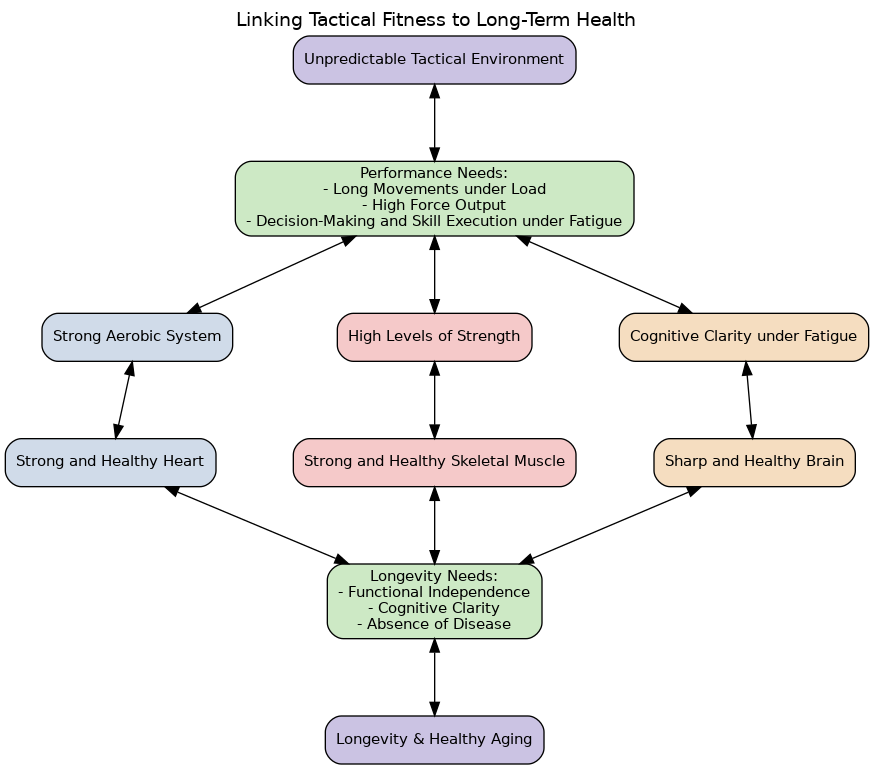
Tactical performance depends on aerobic fitness, strength, and mental clarity—the same qualities that drive healthy aging and long-term vitality.
Performance Now, Longevity Later
The unpredictable nature of the tactical environment might seem frustrating to prepare for—but it actually offers a hidden advantage. Training to meet diverse, high-stakes demands naturally drives well-rounded physical development, which supports long-term health.
In a space crowded with hype and misinformation, research consistently highlights three foundational pillars that truly support longevity:
• Cardiorespiratory Fitness – Strong aerobic fitness is one of the most powerful predictors of long-term health. It’s strongly linked to a lower risk of heart disease and early death—and it actually outperforms traditional risk factors like smoking, high blood pressure, or diabetes when it comes to predicting survival.1,2
• Skeletal Muscle Strength – Strength and muscle function help protect against metabolic dysfunction, frailty, and losing the ability to stay independent as we age. On the flip side, low levels of strength is tied to higher risk of early death and disability in older adults.3,4
• Cognitive Function – Preserving cognitive function is a key component of healthy aging. It supports independence, decision-making, and overall quality of life. Fortunately, staying physically fit—through both cardiovascular and strength training—has been shown to improve mental clarity, memory, and focus, while also helping to guard against long-term decline and dementia.5,6
That’s the hidden advantage of tactical training: the very capacities that drive mission success—cardiovascular fitness, muscular strength, and cognitive clarity—are also the ones most strongly tied to healthy aging. When approached with intention, tactical training can lay a powerful foundation for lifelong health.
Tactical athletes are in a unique position. Their careers require the very attributes that support long-term vitality. So why do so many retired professionals struggle to age well?
The answer is complex and multifactorial, but from a rehab and performance perspective, one reason stands out: years of poor training practices and accumulated orthopedic injuries. Without thoughtful training and proactive injury prevention, even the most capable operators break down—and if they can’t continue training, they can’t sustain the qualities that support healthy aging.
Quick Note: Tactical environments demand a unique kind of mental performance—staying calm under pressure, making rapid decisions, and adapting on the fly. While these demands don’t exactly mirror the cognitive challenges of healthy aging, they rely on many of the same foundational systems. Physical activity, sleep, nutrition, social connection, mental stimulation, and chronic disease management all contribute to long-term brain health. Because Tactical Vitality focuses on training and physical performance, that will remain our primary lens—but these broader influences matter, and shouldn’t be ignored.
The Longevity Cost of Orthopedic Injury
To benefit from the positive effects of fitness over a lifetime, you must continue to train over a lifetime. Building capacity during your operational years is essential—and likely helps buffer age-related decline—but it’s only part of the equation.
Maintaining physical capacity into retirement is what ultimately protects long-term health.
One of the most common roadblocks to maintaining consistent training? Orthopedic injury.
Years of demanding physical training combined with high levels of occupational stress have the potential to wear down the body. When training loads aren’t properly managed through intelligent programming, adequate rest, and movement variety, injury becomes far more likely.
And when injury occurs, training often stops. When that happens, we lose the ability to continue building the capacities that support both performance and longevity.
This raises an important question: How do we train in a way that allows us to reach high levels of performance now—while preserving our bodies for the long haul?
The Tactical Vitality Philosophy
This training philosophy is built to meet the unpredictable demands of tactical work—while protecting your health and performance in the long term. These four principles form its foundation:
1. Train for Range
True readiness means being capable across a wide spectrum of demands—not just excelling in one. This kind of broad, adaptable fitness supports both tactical performance and healthy aging.
2. Exercise Restraint
Pushing one quality to its peak often compromises others. By intentionally leaving some performance on the table, you create space for more balanced, sustainable development—and reduce injury risk. (See Figure 2)
3. Prioritize Consistency
Lasting progress doesn’t come from occasional heroic efforts—it comes from small, repeatable actions done well over time. Consistent training builds capacity, reinforces durability, and creates long-term momentum.
4. Program for Longevity
The way you train today shapes how you perform—and feel—years from now. Smart programming that manages volume, rotates stressors, and builds in recovery protects your tissues, mitigates injury risk, and preserves your ability to train longer.
Figure 2: Diminishing Returns in Fitness Adaptation
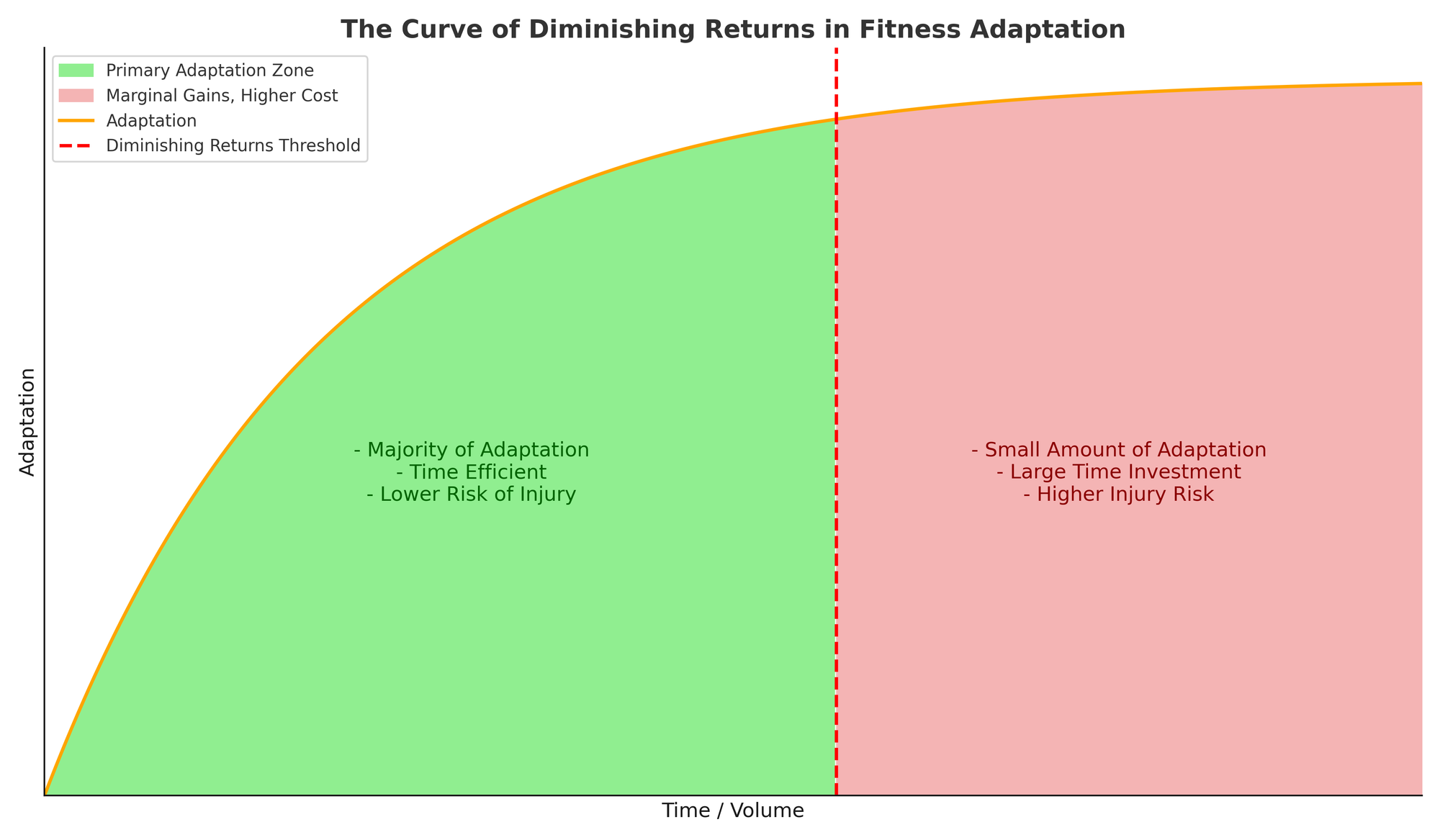
Most fitness gains occur relatively early in the training curve. Beyond a certain point, improvements become marginal while time demands and injury risk rise. Training within the primary adaptation zone supports steady progress and long-term durability—and frees up time and energy to invest in other physical qualities. Leaving a little untapped in one area can open the door to broader, more balanced development.
Looking Forward
We’ve laid the foundation by identifying the core demands of tactical athletes and how to train with both performance and longevity in mind.
In the next post, we’ll begin a deep dive into the cardiovascular system—why it’s essential for tactical athletes, what the research reveals about its impact on long-term health, and how to train it in a way that’s both effective and sustainable.
References
- S, Saito K, Tanaka S, et al. Cardiorespiratory fitness as a quantitative predictor of all-cause mortality and cardiovascular events in healthy men and women: a meta-analysis. JAMA. 2009;301(19):2024–2035. doi:10.1001/jama.2009.681
- Blair SN, Kohl HW 3rd, Paffenbarger RS Jr, et al. Physical fitness and all-cause mortality: a prospective study of healthy men and women. JAMA. 1989;262(17):2395–2401. doi:10.1001/jama.1989.03430170057028
- Volaklis KA, Halle M, Meisinger C. Muscle strength as a risk factor for cardiovascular disease and all-cause mortality: a systematic review and meta-analysis. Scand J Med Sci Sports. 2015;25(1):e1–e12. doi:10.1111/sms.12305
- Newman AB, Kupelian V, Visser M, et al. Strength, but not muscle mass, is associated with mortality in the Health, Aging and Body Composition Study cohort. J Gerontol A Biol Sci Med Sci. 2006;61(1):72–77. doi:10.1093/gerona/61.1.72
- Storoschuk KL, Gharios R, Potter GDM, Galpin AJ, House BT, Wood TR. Strength and multiple types of physical activity predict cognitive function independent of low muscle mass in NHANES 1999–2002. Lifestyle Med. 2023;4(4):e90. doi:10.1002/lim2.90
- Barnes DE, Yaffe K, Satariano WA, Tager IB. A longitudinal study of cardiorespiratory fitness and cognitive function in healthy older adults. J Am Geriatr Soc. 2003;51(4):459–465. doi:10.1046/j.1532-5415.2003.51153.x